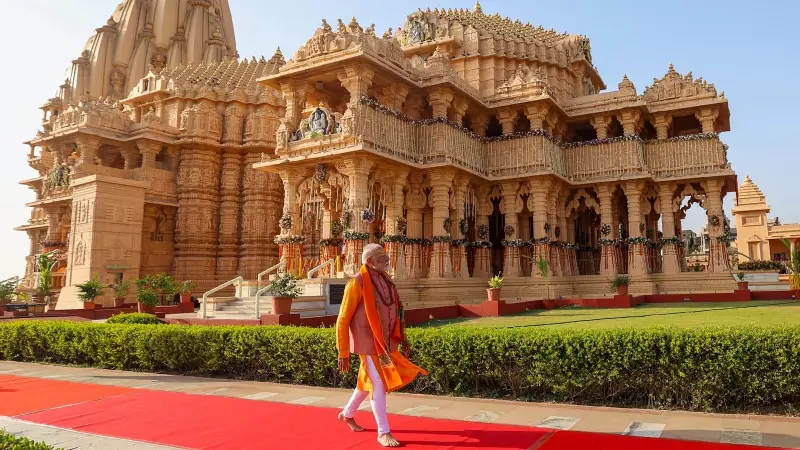
Prime Minister Narendra Modi's decision to spend two nights at the Somnath temple in Gujarat is being interpreted as a profound political and civilisational statement. In Indian political culture, the duration of a leader's visit often carries more weight than the visit itself. A brief stop signifies courtesy, while an extended stay denotes deep intention and commitment.
The Significance of Duration: From Visit to Contemplation
This two-night pause, which took place in early January 2026, follows the Prime Minister's recent reflections on India's long civilisational memory and resilience. It represents a deliberate act of re-embedding the modern Indian state within a historical geography defined by both rupture and continuity. The Somnath temple, repeatedly destroyed and rebuilt, stands as a ultimate testament to civilisational endurance.
For decades following India's independence, the narrative around Somnath was often met with official embarrassment. India's first Prime Minister, Jawaharlal Nehru, notably disapproved of its reconstruction. This stance exemplified a state policy of selective amnesia, where historical trauma was acknowledged only if it could be universalized, otherwise risked being dismissed as parochial. Wounds demanding recognition were frequently ignored or outright denied.

Acknowledging History Without Festering Wounds
Analysts observe that Prime Minister Modi practices a distinct politics of emphasis. His approach does not seek to erase historical wounds but to openly acknowledge them, a process believed to prevent them from festering. By mentioning Somnath and Ghazni in the same narrative breath, he advances a nuanced argument: India's path forward is not about avenging the past, but about understanding it without apology or insecurity.
The act of staying holds sacred value in Indic tradition. Historically, kings did not merely pay fleeting visits to temples; they resided, listened, and absorbed, acknowledging that even sovereign power must bow to time and learn. Modi's stay echoes this tradition, transforming the location from a mere speech-stop into a space for contemplative pause.
Redefining Identity in a Civilisational State
This event occurs as India actively redefines itself as a civilisational state, where symbols are imbued with intense meaning. While the Islamic world anchors legitimacy in sacred geography, the West mythologizes the Enlightenment, and China foregrounds its ancient continuity, India uniquely attempted to compress its millennia-old civilisation into a framework of constitutionalism alone. This is particularly ironic given that the framers of the Indian Constitution themselves acknowledged this deep civilisational inheritance.
Therefore, the Prime Minister's extended stay is interpreted not as a message of division or supremacy, but one of solemn presence and acknowledgement. It is a clarifying statement that India is no longer in denial of its lived historical experiences. Critics may label it as "majoritarian signalling," but proponents argue that India's civilisational story is not the exclusive property of one community. A nation confident in its civilisational foundations, they contend, has little use for superficial or performative secularism.
By invoking Ghazni in the context of resilience and honoring Somnath without insecurity, the narrative is being repositioned away from perpetual grievance. The two-night sojourn serves as a reminder to the political class that true power must sometimes pause and reflect. The ultimate message is one of endurance: civilisations do not need to shout; they persist through time.