Modi's Pongal Address: A Strategic Tamil Outreach Before State Polls
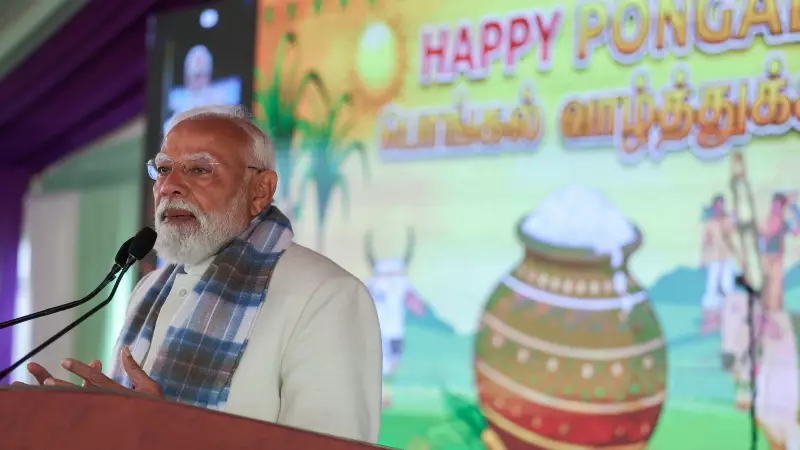
Prime Minister Narendra Modi delivered a significant address during a Pongal celebration event in New Delhi on Wednesday. He spoke at the residence of Union Minister of State L Murugan, a BJP leader. The Prime Minister used this platform to praise Tamil culture extensively, calling it one of the world's oldest living civilizations. He emphasized that this rich heritage belongs to the entire nation, not just Tamil Nadu.
Timing Amid Political Friction
This speech arrives at a crucial moment. There is noticeable friction between the central government and the DMK-led administration in Tamil Nadu. Chief Minister M K Stalin's party has repeatedly accused the BJP of pushing Hindi imposition across India. The DMK has labeled Hindi as a hegemonic language while highlighting what it calls the underdevelopment of Hindi-speaking states.
Assembly elections in Tamil Nadu are scheduled for April this year. Political observers see Modi's address as a clear outreach to Tamil voters. The BJP has historically been weak in the state and is attempting to expand its presence. The party understands the deep sensitivity surrounding language and cultural identity for Tamil people.

Emphasis on Cultural Unity and Shared Heritage
Modi made several key points during his Pongal message. He stated, "Tamil culture connects centuries together, learning from history and guiding the present towards the future." The Prime Minister underlined that today's India draws strength from its ancient roots while moving toward new possibilities.
He connected various cultural experiences to illustrate this unity. Modi recalled his visit to the 1,000-year-old Gangaikonda Cholapuram temple in Tamil Nadu last July. He mentioned the Kashi Tamil Sangamam in Varanasi, where he felt a strong connection with cultural unity. The Prime Minister also referenced his April 2025 visit to Rameswaram for the Pamban Bridge inauguration, saying he witnessed the greatness of Tamil history firsthand.
Modi noted that multiple festivals like Lohri, Makar Sankranti, and Magh Bihu are celebrated across India on the same day. This, he suggested, shows the country's inherent cultural unity. The Prime Minister pitched for 'Ek Bharat, Shreshtha Bharat' – one India, excellent India – as a guiding vision.
Ongoing BJP-DMK Language and Culture Debate
This is not the first time Modi has praised Tamil culture amid political tensions. On April 15, 2024, he called Tamil the world's oldest language, expressing India's pride in it. Interestingly, the DMK also maintains that Tamil is the oldest living language globally.
However, their perspectives diverge significantly. The BJP views Tamil civilization and language as a vital subset of India's ancient heritage. The party frames it within a broader national narrative. In contrast, the DMK emphasizes the distinctiveness of Tamil language and culture. The party sees it as separate from what it terms the "Sanskrit-Aryan culture" associated with northern India.
Deep-Rooted Language Row
The conflict extends beyond political statements. On February 27, 2025, Stalin called Hindi a hegemonic language. He claimed it destroyed more than twenty-five native languages in north India. Stalin argued that the Dravidian movement protected Tamil through awareness and agitation. He described Hindi as merely a mask with Sanskrit as the face behind it.
Activist Yogendra Yadav disagreed with this critique. He said blaming only Hindi for assimilating other languages is factually weak. Yadav noted all modern Indian languages have standardized by subsuming neighboring dialects. He supported recognition for all languages but rejected singling out Hindi.
The central government's three-language formula has further fueled disagreements. While the Centre says the third language can be any Indian language, Tamil Nadu leaders see this as a covert push for Hindi. State minister P T Rajan wrote in March 2025 that Tamil Nadu's two-language formula works well. He pointed to the state's higher literacy rates and education enrollment as proof.

Historical and Archaeological Dimensions
The debate also involves historical claims. A 2023 report by archaeologist K Amarnath Ramakrishna suggested urban habitation at Keeladi near Madurai dates back to the 8th-5th century BC. This challenges the theory that urbanization spread from north to south. It potentially places Keeladi as contemporary with northern urban sites from the 6th century BC.
In January 2025, Stalin announced a one-million-dollar prize for deciphering the Harappan script. Harappa is located in the northwest subcontinent, far from Tamil Nadu. Many interpreted this as an attempt to find Tamil-Harappan linkages. Such a connection could position Tamil culture as older than Vedic culture, strengthening the Aryan-Dravidian binary narrative.
Modi's Pongal address strategically navigates these complex cultural and political waters. By celebrating Tamil heritage as a national treasure, he aims to foster unity. Yet the underlying tensions with the DMK over language, culture, and identity remain palpable as election season approaches in Tamil Nadu.