

Parliament's Stalemate: Government Dominance and Opposition Ineffectiveness
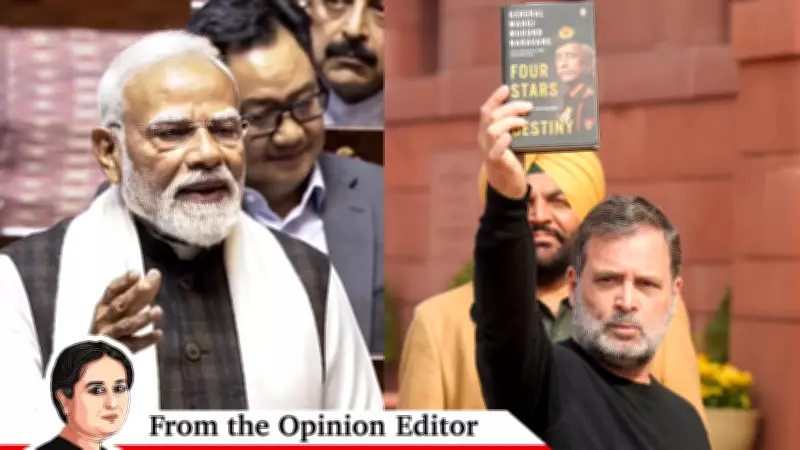
The recent parliamentary sessions have underscored a recurring theme in Indian politics: the government's firm control and the Opposition's struggle to assert its voice. As the President outlined the policy agenda and the Finance Minister presented the Budget, the discussion on the motion of thanks in Lok Sabha saw the Opposition largely sidelined. A confrontation erupted when the Leader of Opposition attempted to cite excerpts from a former army chief's unpublished memoirs, leading the Speaker to disallow his speech and suspend eight Opposition MPs. Meanwhile, in Rajya Sabha, Prime Minister Narendra Modi delivered a lengthy address, reinforcing patterns that have defined his tenure.
Modi's Speech: A Familiar Narrative of Transformation and Anti-Congressism
In his 97-minute speech, PM Modi adhered to a well-established template, contrasting India before and after 2014, the year he assumed office. He painted a picture of a nation in ceaseless forward motion, highlighting trade deals with the EU and US as evidence of global recognition. Central to his rhetoric was a visceral anti-Congress theme, emphasizing that despite the Congress party's declining electoral fortunes, the BJP continues to view it as the primary opponent. This focus suggests an acknowledgment that, even in its weakened state, the Congress remains the only rival capable of offering a nationwide ideological challenge, unlike regional parties with narrower scopes.
The Opposition's Self-Defeating Patterns
While the government and Speaker collaborated to limit Opposition spaces, the Congress-led bloc failed to devise effective counterstrategies. Leader of Opposition Rahul Gandhi's actions, rather than breaking the cycle, exacerbated the situation. By focusing on a contentious issue involving the PM's decision-making during a crisis, he led to the suspension of MPs and deprived others from key states like Assam, West Bengal, Kerala, and Tamil Nadu of speaking opportunities. This approach not only mirrored Modi's self-centric narrative but also highlighted a lack of political creativity in opposing the government.

Alternative Approaches and Broader Implications
In contrast, Mallikarjun Kharge's speech in Rajya Sabha demonstrated a more nuanced opposition strategy. He shifted focus from Modi alone to the government's broader record, critiquing issues such as social justice, communal harmony, parliamentary processes, and safety nets for workers and farmers, including aspects of the India-US deal. This highlights a potential path for the Opposition: moving beyond personalized attacks to address systemic concerns. However, the prevailing sameness in parliamentary dynamics hurts the Opposition more, denying it the platform to articulate alternative visions and hold power accountable.
The ongoing parliamentary impasse reflects deeper political rifts, with anti-Congressism remaining a cornerstone of Modi-BJP politics. For the Opposition, breaking free from reflexive patterns is crucial to reclaiming its voice and ensuring robust democratic debate in the House.






