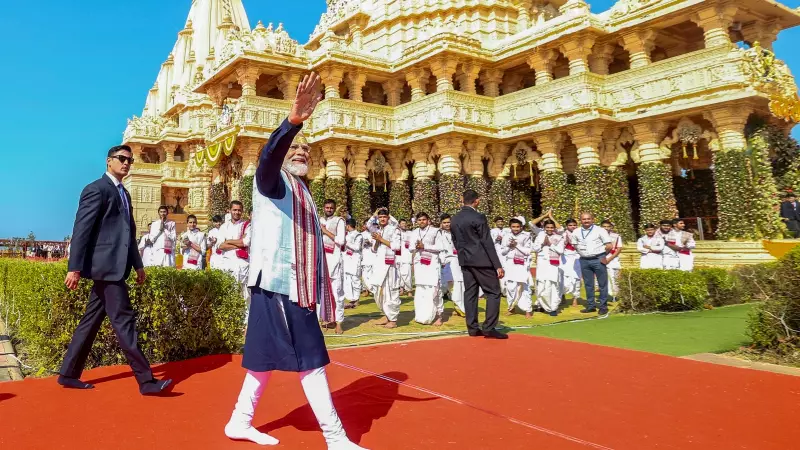
Prime Minister Narendra Modi delivered a powerful address at the Somnath temple in Gujarat on Sunday, marking a dual milestone: 1,000 years since the temple's destruction by Mahmud of Ghazni in 1026 and 75 years since its reconstruction in 1951. Speaking at the concluding event of the Somnath Swabhiman Parv, the Prime Minister framed the temple not as a symbol of destruction but of India's enduring civilisational resilience, while issuing a sharp warning against divisive forces that persist today.
A Warning Against a 'Slavish Mentality'
In a direct critique, Modi targeted those with what he termed a "slavish mentality" who opposed the reconstruction of the Somnath temple soon after India gained independence. He asserted that such elements are still present in the country and called for vigilance. "Unfortunately, there are still those in our country who oppose the reconstruction of the Somnath temple. But today, instead of swords, their conspiracies involve other weapons. So we must be more careful and make ourselves strong, be united and stop every such power trying to divide us," the Prime Minister stated.
He elaborated on historical opposition, recalling how efforts were made to stop Sardar Vallabhbhai Patel from rebuilding the temple and how objections were raised over President Rajendra Prasad's planned visit in 1951. Modi credited Maharaja Digvijaysinhji, the Jam Saheb, for stepping in, preserving national pride, and donating Rs 1 lakh to lead the reconstruction trust.

Somnath: A Testament to Unbroken Civilisation
Modi emphasized that the event was a commemoration of cultural resilience, not destruction. "It is the wheel of time at work… religious fanatics who came to destroy temples have been relegated to the pages of history while Somnath temple still stands at the same place, its flag still flying," he said.
He provided a timeline of repeated attacks on the temple, arguing that the motive was not mere material loot but a concerted effort to alter its fundamental nature. "The true history of hate, torture and terror was hidden from us," Modi said, accusing some historians and politicians of whitewashing the actions of the attackers. He also lamented that local heroes who defended Somnath, like Raval Kanhad, Veer Hamirji Gohil, and Vegada Bhil, were forgotten due to this mentality.
Linking Heritage to a Future Vision
The Prime Minister drew a direct line from India's reclaimed heritage to its future aspirations. Recalling his speech at the consecration of the Ram temple in Ayodhya, he spoke of a "grand dream for the next 1,000 years." "Today, every countryman has belief in a Viksit Bharat. We will defeat poverty and touch new heights. First, becoming the world’s third largest economy. We are ready to march ahead," Modi declared.
He posited that the survival of Somnath and India through centuries of attacks was because "Bharat and its Aastha Kendras (centres of faith) are intermingled with each other."
Beyond the historical and political narrative, the Prime Minister also highlighted modern development initiatives for the region, including:
- New airports at Keshod and Rajkot.
- The Ahmedabad-Veraval Vande Bharat train service.
- Various infrastructure works under the Yatra Dham development project.
- Initiatives for lion conservation.
Prime Minister Modi's speech at Somnath thus wove together threads of historical rectification, a caution against contemporary divisive politics, and a forward-looking vision for a developed India, all anchored in the symbolic power of the ancient temple.