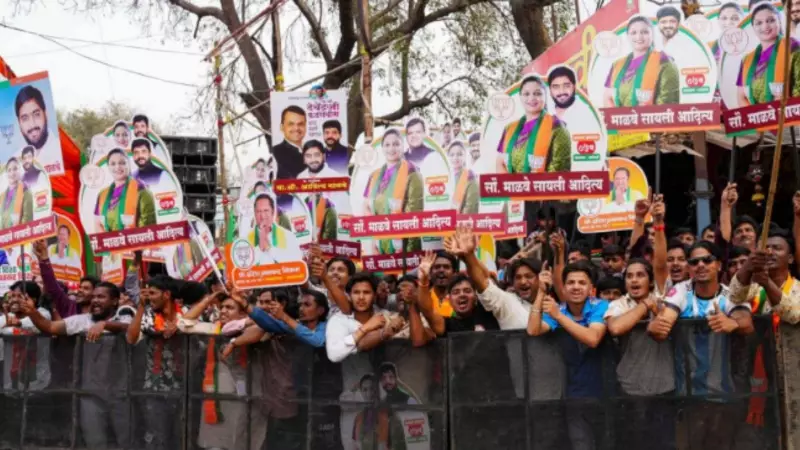
Maharashtra Civic Polls Turn into Survival Battle for Regional Parties
Maharashtra's municipal corporation elections, scheduled for Thursday, have transformed into a fierce struggle for survival. Regional parties within both the ruling Mahayuti and opposition Maha Vikas Aghadi alliances face this critical test. Twenty-nine municipal corporations across the state will witness this electoral contest.
BJP Launches Unprecedented Grassroots Campaign
The Bharatiya Janata Party has surprised many with its aggressive campaigning strategy. Chief Minister Devendra Fadnavis defended the party's intense electioneering efforts. He emphasized the crucial role of grassroots workers in local body elections.
"Many people ridicule my hectic campaign schedule and numerous rallies," Fadnavis stated. "They fail to understand that these local elections depend entirely on our karyakartas. Supporting our dedicated workers remains our fundamental duty. These committed individuals form the backbone of our organization."

The Chief Minister contrasted the BJP's approach with rival parties. He specifically mentioned the Congress and Uddhav Thackeray's Shiv Sena faction. "Neglecting grassroots workers leads to a party's downfall," Fadnavis asserted.
Strategic Campaign Decisions Shape Electoral Dynamics
BJP's election managers devised a targeted campaign approach. They prepared a list of forty star campaigners, including leaders from outside Maharashtra. These campaigners aimed to connect with diverse caste and community groups across the state.
Interestingly, the party deliberately avoided campaign events featuring Prime Minister Narendra Modi and Home Minister Amit Shah. Fadnavis convinced the central leadership that he could effectively reach voters across all municipal corporations. The BJP feared that highlighting national leaders might backfire during local polls.
"A campaign centered on Modi and Shah could prove counterproductive," party strategists reasoned. "It might give opposition parties opportunities to raise national issues in local elections."
Marathi Identity Emerges as Central Campaign Theme
These elections witnessed a remarkable political reunion. Uddhav Thackeray and his cousin Raj Thackeray joined forces after two decades of separation. Their campaign focused intensely on Marathi pride and regional identity.
The Thackeray cousins invoked historical sentiments during their rallies. They referenced the Samyukta Maharashtra Samiti movement from the 1950s. This movement originally demanded a separate Marathi-speaking state.
Raj Thackeray addressed a large gathering at Mumbai's Shivaji Park. "Modi and Shah have unleashed industrialists to capture Mumbai's land," he declared. "Losing land and language makes you an outsider in your own state. This represents the BJP's long-term plan to displace Marathi people from Mumbai."
Uddhav Thackeray echoed similar concerns at the same rally. "All major projects from Mumbai have been relocated to Gujarat," he claimed.
Political Parties Adapt to Marathi Sentiment
The Thackerays' emphasis on Marathi identity forced other parties to respond. The BJP countered with its Hindutva platform while criticizing the opposition's Muslim outreach. BJP leaders promised a Hindu-Marathi mayor for Mumbai if they won the elections.
BJP minister Ashish Shelar highlighted the party's commitment to Marathi communities. "We have demonstrated our dedication through concrete actions," Shelar stated. "Granting classical language status to Marathi and providing affordable housing through BDD chawl redevelopment prove our commitment."
Fadnavis pointed to electoral history as evidence. "Without Marathi support, the BJP could not have become the largest party in three consecutive Assembly elections," he argued.
Congress Navigates Complex Electoral Landscape
The Congress party faced multiple challenges during this campaign. While focusing on traditional voter bases including north Indian migrants, Dalits, and Muslims, they could not ignore Marathi sentiments.
State Congress president Harshvardhan Sapkal addressed these concerns. "Our party alone raises voices against industrialists exploiting Marathi people in Mumbai," he claimed.

Migrant Voters Become Crucial Electoral Factor
Mumbai witnessed several anti-migrant incidents during the past year. Maharashtra Navnirman Sena workers allegedly targeted migrants for not speaking Marathi. Surprisingly, migration issues received less emphasis during the campaign.
The Thackeray cousins cautiously approached migrant communities. They feared that excessive polarization might push migrant voters toward the BJP. North Indians constitute over twenty percent of Mumbai's population.
As Congress popularity declined across Maharashtra, many north Indian voters shifted allegiance to the BJP. The party now relies on north Indian and Gujarati communities to counter Marathi sentiment in BMC elections.
Alliance Fractures Create Multi-Cornered Contests
State-level alliances remained formally intact, but municipal elections caused internal fractures. Both Mahayuti and MVA alliances experienced splits, resulting in multi-cornered contests across several corporations.
Within the ruling Mahayuti alliance, the BJP and Eknath Shinde's Shiv Sena cooperate in fourteen municipal corporations. These include Mumbai, Thane, and Nagpur. However, they compete directly in fifteen other civic bodies.
The BJP and Ajit Pawar's NCP contest separately, with Pune and Pimpri-Chinchwad witnessing particularly intense battles. This failure to unite indicates underlying power struggles within the alliance.
On the opposition front, the Sena (UBT), MNS, and Sharad Pawar's NCP face existential challenges. Following their poor performance in the 2024 Assembly elections, these local body elections represent a do-or-die battle for survival.
In a tactical move, Sharad Pawar's NCP faction allied with Ajit Pawar's NCP in Pune and Pimpri-Chinchwad. This strategic partnership aims to prevent vote division in crucial constituencies.
Brihanmumbai Municipal Corporation Takes Center Stage
Among all municipal corporations, the Brihanmumbai Municipal Corporation attracts maximum attention. As India's wealthiest civic body, BMC elections always generate intense political competition. This year's contest features particularly high stakes for all participating parties.
Fractured coalitions and Marathi identity assertions have defined this election cycle. Regional parties fight for survival while national parties seek to expand their influence. Thursday's voting will determine the political landscape of Maharashtra's urban centers for years to come.