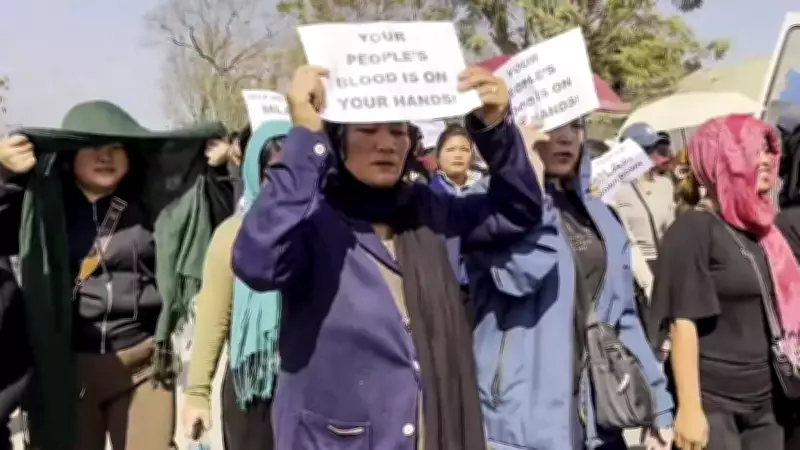
Kuki Protests Challenge Manipur's New Government Amid Fragile Peace
The recent formation of a popular government in Manipur has been met with significant unrest, as Kuki-Zo civil society organizations stage protests against the participation of Kuki MLAs in the state administration. This development casts a shadow over efforts to re-establish an elected government, following a period of political vacuum. However, authorities in New Delhi view these disturbances as temporary challenges in a political landscape still deeply influenced by ethnic sentiments.
Government's Assessment: Protests as Posturing Rather Than Prolonged Conflict
According to sources within the Ministry of Home Affairs (MHA), the protests in the hills by civil society groups are perceived more as strategic posturing than a genuine declaration of long-term non-cooperation with the newly formed government. Officials express confidence that the situation is likely to stabilize within the next few days, attributing the unrest to expected teething troubles in a sensitive political environment.
An MHA official explained, "The sporadic violence and protests we are witnessing were anticipated. Kuki groups had publicly stated that their MLAs would not join the government without a written assurance from the Centre regarding their demand for a separate administration before the current Assembly's tenure ends. Since no such assurance was provided, yet their MLAs participated, protests serve to maintain credibility with their community."

Behind the Scenes: Negotiations and Strategic Appointments
Sources reveal that the Kuki MLAs' decision to join the government followed approval from key militant organizations, including the Kuki National Organisation (KNO) and the United People’s Front (UPF), both part of the Suspension of Operation (SoO) agreement with the Centre. These groups are engaged in ongoing talks with the government to develop a political solution for Manipur's hill tribes.
Another official noted, "Both the KNO and UPF agreed to government formation as early as September 2025. The appointment of Deputy CM Nemcha Kipgen, wife of a prominent UPF leader, underscores this coordination. However, public sentiment around the 'non-negotiable' separate administration demand has fueled the protests."
Criticism of the Kuki MLAs has primarily come from organizations like the Kuki-Zo Council (KZC) and Kuki Students’ Organisation (KSO), rather than the KNO and UPF, highlighting internal divisions within the community.
Strategic Importance of Deputy CM Choice and Ongoing Dialogues
The details of government formation were meticulously negotiated over weeks, with the selection of Nemcha Kipgen as Deputy CM informed by both her seniority among Kuki MLAs and her representation of the Kangpokpi constituency. This region has been a flashpoint since violence erupted in the state, with Kuki organizations frequently blocking the key highway connecting the Imphal Valley to mainland India.
Sources indicate that appointing an MLA from this area as Deputy CM was intended to ease tensions and ensure the highway remains open, facilitating movement and commerce.
An MHA official added, "Dialogues with all stakeholders are ongoing, and Kuki groups have been assured that their concerns, including the separate administration demand, will be addressed. They understand that deadlines cannot be imposed on New Delhi, and the state's territorial integrity, as outlined in the SoO agreement, must be preserved."
Looking Ahead: Engagement and Stability
The Union government hopes that as the state government begins functioning, all societal sections will engage with it, leveraging the end of a prolonged political vacuum. The expectation is that practical governance and continued dialogue will gradually mitigate current tensions, fostering a more stable environment in Manipur.
In summary, while Kuki protests test Manipur's fragile peace, careful political maneuvers and ongoing negotiations provide a foundation for potential calm, with authorities optimistic about near-term resolution.