Kolkata, known for its love of adda over tea and food, has turned into a hub of political discussion as the gap between polling day and result day stretches longer than usual. With voting ending on April 29 and counting scheduled for May 4, the extended period—further lengthened by a long weekend—has transformed the city into a giant echo chamber of speculation, satire, anxiety, and amusement. From tea stalls to living rooms, buses to metro compartments, one question echoes endlessly: "Ki hobe?" (What will happen?).
Tea Stalls Turn into Debate Arenas
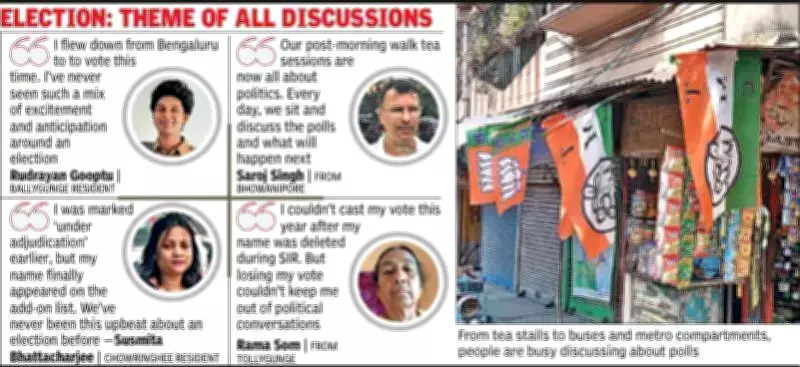
At a tea stall on Harish Mukherjee Road, regulars clutching earthen cups have taken on the role of amateur psephologists. Booth-level turnout figures are debated with surprising fluency, as if results could be reverse-engineered through sheer discussion. "Turnout has been exceptionally high this year, even in the city. That usually means something," said Saroj Singh, a Bhowanipore-based businessman. His friend, Kapil Prasad, quickly tempered the confidence: "This election is about narratives as much as numbers. It's not easy to predict."
Addas Spread Across the City
Such exchanges are playing out across Kolkata—in rowaks (verandahs), cafes, restaurants, and drawing rooms—where political allegiance and poll arithmetic have become central themes of conversation. Even those unable to vote are following developments through family members and neighbors. Rudrayan Gooptu, who works in Bengaluru, returned to Bhowanipore to cast his vote. What struck him was not just the participation but the mood that followed. "There's a mix of excitement and anticipation, but also a quiet tension now. People seem to be watching more closely than usual," he said.

Family Gatherings Reflect Political Divide
A similar sentiment was echoed by Soumya Mukherjee, a bank executive who extended his stay in Kolkata for the results. After nearly a year away, he found himself immersed in political discussions at every gathering. Among them, there were "SIR victims"—those affected by the Sandeshkhali incident. Family gatherings have mirrored the broader political divide. At a lunch in Fariapukur, opinions were split almost evenly between supporters of the BJP and the Trinamool Congress. "People are frustrated with corruption and lack of jobs," said Soumalya Chakraborty, a retired central government employee. His brother-in-law, Goutam Mukherjee, offered a counterpoint: "People also remember how things have improved since the Left era. Welfare schemes matter, and there are concerns about increasing polarisation if there is a change in power," he argued.
Public Transport and WhatsApp Groups Join the Fray
The city's public transport system has become another stage for these debates. On a bus inching through traffic between Esplanade and Sealdah, a loud exchange between two office-goers drew in half the passengers. WhatsApp groups are also abuzz with discussions, with members sharing news, opinions, and even memes about the election. The long wait for results has turned Kolkata into a city of political pundits, where every citizen has a theory and every adda is a mini-debate.