Karnataka Governor's Abbreviated Address Ignites Constitutional Confrontation
In a dramatic turn of events at the Karnataka legislature on Thursday, Governor Thaawar Chand Gehlot delivered what was supposed to be a comprehensive 43-page address in merely three lines before making a swift exit, bypassing the national anthem entirely. This unprecedented action marks the third consecutive day of escalating tensions between Raj Bhavan and state governments in non-BJP ruled states, highlighting a deepening rift over gubernatorial speeches and constitutional protocols.
Governor's Condensed Communication and Immediate Backlash
Governor Gehlot's brief statement, which lasted only moments, consisted of the following: "I am happy to address one more joint session of the Karnataka legislature. My government is fully committed to doubling the speed of economic, social and physical development of the state. Jai Hind, Jai Karnataka." His premature conclusion was met with a thunderous roar of disapproval from the bewildered Congress benches, who expressed their shock and frustration at what they perceived as a blatant disregard for legislative decorum.
Chief Minister Siddaramaiah immediately condemned the governor's actions, labeling them as "unconstitutional" and accusing Gehlot of being "a puppet" of the central government. Siddaramaiah announced that the state government is seriously contemplating taking this contentious issue to the Supreme Court, seeking judicial intervention to address what they view as a severe breach of constitutional duties.

Constitutional Violations and the Drafted Speech Controversy
According to Siddaramaiah, Governor Gehlot not only failed to fulfill his constitutional responsibilities but also deliberately ignored the meticulously prepared speech drafted by the state government. This action is alleged to violate Articles 176 and 163 of the Indian Constitution, which explicitly mandate that the governor's address at the commencement of the year's first legislative session must reflect the voice and policies of the state cabinet.
The Congress government had drafted an extensive 122-paragraph speech for this occasion, detailing numerous grievances and highlighting what they describe as "injustice to the state in tax devolution and several central schemes." The draft included strong criticism of the central government for allegedly "repealing" the Mahatma Gandhi National Rural Employment Guarantee Act (MGNREGA). This claim was directly contested by Governor Gehlot on Wednesday, who stated that the central scheme had merely been "technically modified, not repealed."
Legislative Chaos and Political Reactions
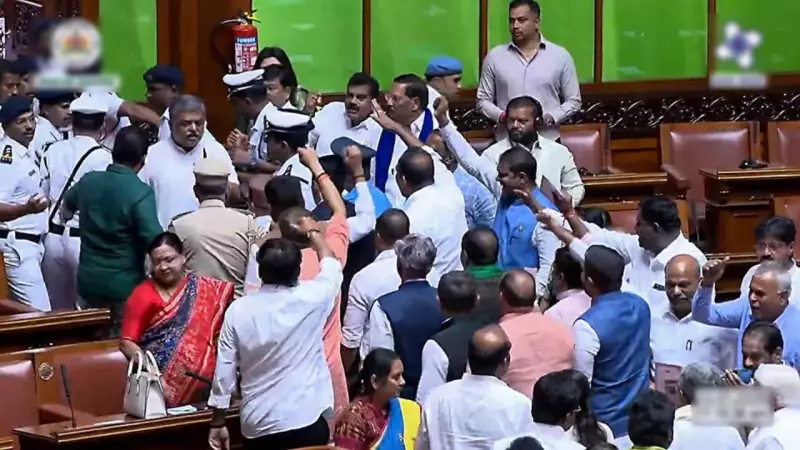
Governor Gehlot's refusal to read the prepared speech led to immediate uproar within the legislative chamber. Congress members erupted in chants of "shame...shame" as he strode off the podium. The situation escalated further when some Congress members, including MLC BK Hariprasad, attempted to heckle the governor before being swiftly removed by marshals, adding to the chaotic atmosphere.
In stark contrast, BJP members came to the governor's defense, raising slogans of "Bharat Mata ki jai" and supporting his decision. BJP state president B Y Vijayendra demanded strict action against Congress MLAs and MLCs for what he described as attempts to undermine the authority of Raj Bhavan. Vijayendra also defended the modifications to MGNREGA, stating that its replacement with VB-G RAM G aligns with Prime Minister Narendra Modi's visionary approach to governance.
Broader Pattern of Gubernatorial Conflicts in Southern States
Thursday's contentious episode in Karnataka is not an isolated incident but part of a broader pattern of conflicts involving governors and state governments in southern India. Earlier in the week, Tamil Nadu Governor RN Ravi walked out of the assembly without delivering his scheduled address on the opening day of the legislative session, citing "inaccuracies" in the prepared text.

Similarly, in Kerala, Governor Rajendra Viswanath Arlekar allegedly omitted significant portions of his scheduled address, with Raj Bhavan officials claiming that their suggestions had been excluded from the draft speech. These consecutive incidents highlight a growing trend of friction between state administrations and gubernatorial offices in regions where the ruling party at the state level differs from that at the center.
Political Accusations and Legislative Aftermath
BJP legislators have accused the Congress party of misusing the legislature to foster resentment against the central government, asserting that Governor Gehlot's response was appropriate given the circumstances. The legislative session was ultimately adjourned without completing any of the scheduled proceedings for the opening day, leaving critical state business in limbo.
In response to the security measures taken during the fracas, Congress announced plans to move a privilege motion against the conduct of security staff, further escalating the political confrontation. This series of events underscores the deepening political divisions and constitutional challenges facing India's federal structure, particularly in states where political alignments create inherent tensions between elected governments and appointed governors.