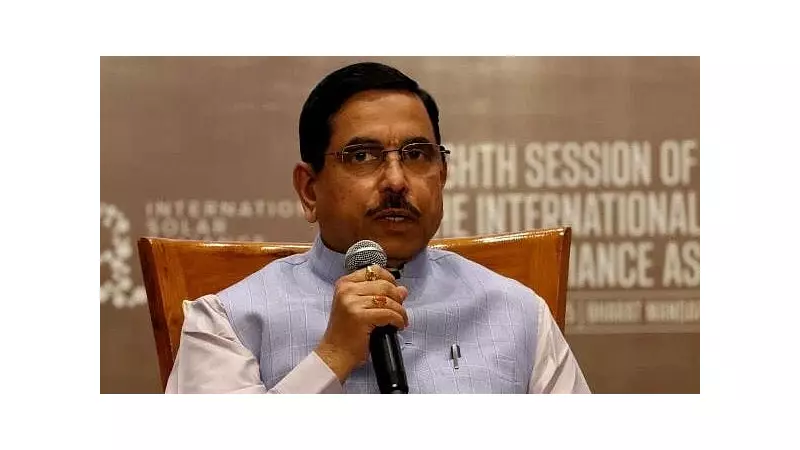
Union Minister Pralhad Joshi has levelled a serious accusation against the previous Congress-led United Progressive Alliance (UPA) government, alleging corruption to the tune of a staggering Rs 11 lakh crore in the flagship Mahatma Gandhi National Rural Employment Guarantee Act (MGNREGA) scheme.
The Core Allegations and CAG Findings
Joshi stated that the Congress party has not denied these allegations related to its tenure. He pointed to the Comptroller and Auditor General (CAG) report of 2013 as a key piece of evidence, which had flagged severe irregularities in the scheme's implementation.
According to the minister, the CAG audit had uncovered the existence of 4.33 lakh fake job cards across the country during the UPA regime. These fraudulent cards were allegedly used to siphon off funds meant for providing livelihood security to rural households.

Misuse of Machinery and Systemic Loopholes
Further elaborating on the malpractices, Joshi highlighted that work which was supposed to be manual and labour-intensive was being executed using JCB machines and other mechanical equipment. This practice violated the core objective of MGNREGA, which is to provide wage employment to unskilled manual workers, thereby defeating the purpose of asset creation and employment generation.
The minister asserted that such illegalities and systemic loopholes were rampant, leading to the massive estimated loss of public money.
The Government's Corrective Measure: The VBG RAM G Act
Joshi explained that to put an end to these widespread irregularities and to bring in greater transparency and accountability, the current government has introduced the VBG RAM G Act. While the minister did not elaborate on the full form of the act in his statement, it is presented as a legislative tool designed to plug the loopholes that were exploited during the earlier administration.
The allegations, made on January 9, 2026, add a new chapter to the long-standing political debate over the implementation and integrity of one of the world's largest social welfare schemes. The claims underscore the ongoing scrutiny of past governance and the current administration's focus on rectifying what it terms as institutional weaknesses.