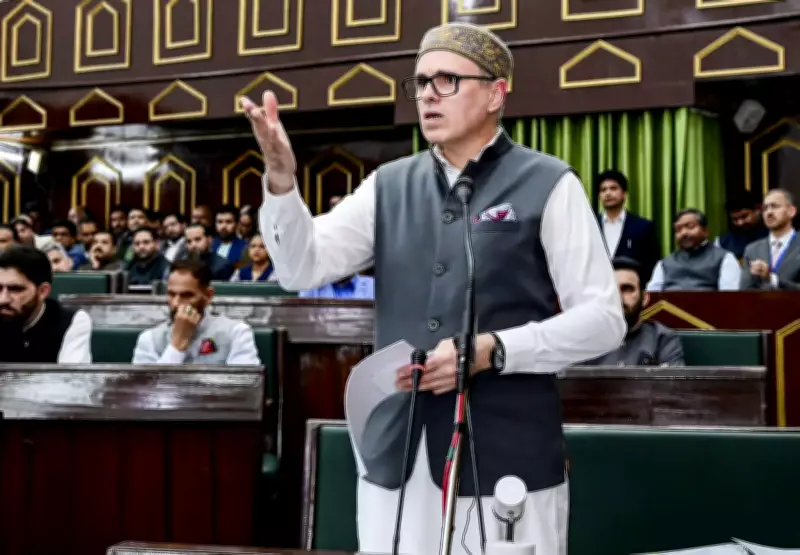
Jammu and Kashmir Chief Minister Opposes Media Censorship and Ad Pressure
In a significant address to the Jammu and Kashmir Legislative Assembly in Jammu, Chief Minister Omar Abdullah firmly stated his opposition to media censorship and the use of government advertisements to influence news coverage. During the passage of finance grants on Thursday, Abdullah emphasized his commitment to press freedom and transparency in governance.
Rejection of Media Manipulation Tactics
Omar Abdullah declared, "I have never asked any media house not to write against me or in my favor." He explicitly rejected the practice of using advertisements as leverage, adding, "I will never use advertisements as a pressure point." The Chief Minister further noted that he does not call newspapers to question their reporting about him, distinguishing himself from those who employ such tactics to exert control over media narratives.
Rationalization of Advertisement Policy for Greater Transparency
However, Abdullah acknowledged the need for reforming the government's advertisement policy to ensure greater transparency and fairness. He proposed that advertisement allocation should be based on objective criteria such as circulation, readership, and audience reach. "Several members mentioned newspapers that many of us have not even seen. But they receive advertisements. It raises questions about how advertisements are being allocated and who takes those decisions," he remarked. Abdullah stressed that a data-driven approach, focusing on the actual impact of media outlets, should form the foundation for distributing advertisements, moving away from subjective or politically motivated decisions.

Employment Initiatives and Job Creation Efforts
On the issue of vacancies and employment, Omar Abdullah clarified the distinction between creating posts and making appointments. He reported that the government has filled approximately 6,000 to 6,500 posts and reiterated plans to fill around 30,000 vacant positions this year. These recruitments will be conducted through transparent and time-bound processes in coordination with the Service Selection Board and Public Service Commission. Additionally, Abdullah referred to outsourcing engagements as supplementary opportunities that, while not counted as formal jobs, provide livelihoods. "At least they are earning a living," he noted, highlighting the practical benefits of such arrangements.
Financial Constraints and Climate Change Imperatives
Addressing financial challenges, Abdullah pointed out that Jammu and Kashmir faces significant constraints, with tax and non-tax revenues covering only about 25% of expenditures. The remaining 75% comes from central share and assistance, a situation he described as inherited rather than newly created. Efforts are underway to enhance financial self-reliance and reduce dependency on external funds.
Furthermore, Abdullah emphasized that climate response has become a compulsion for Jammu and Kashmir, particularly following the impacts of drought and heavy rains in the previous year. A fund for climate change mitigation has been prepared, and he stressed the necessity of assigning departmental responsibility to study and address climate change impacts before implementing further budgetary measures. This proactive approach aims to safeguard the region against environmental vulnerabilities.
Tourism Revival and Future Prospects
Regarding tourism, Omar Abdullah highlighted the successful revival of the industry despite difficult circumstances, including the tragic Pahalgam terror attack. "Today, Gulmarg hotels are full. Sonamarg hotels are full," he stated, indicating a positive turnaround. With the intervention of the Centre, several destinations have been reopened, and Abdullah expressed hope that by May, all remaining closed destinations would be accessible again, boosting the local economy and restoring normalcy.