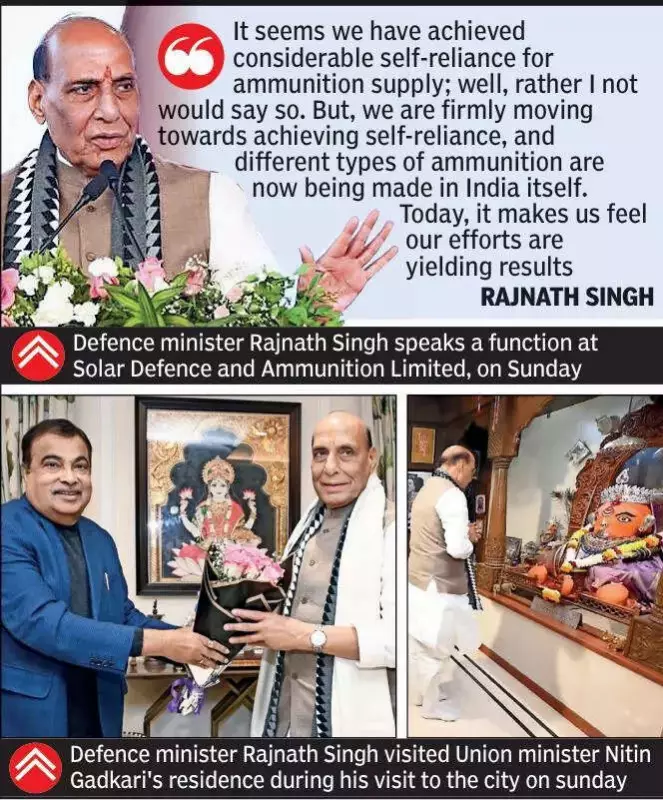
Defence Minister Rajnath Singh addressed a critical issue on Sunday. He stated that India faced a shortage of ammunition for a long period. This scarcity sometimes impacted strategic planning across various fronts. Even with the best equipment and platforms available, systems could not achieve optimal use due to this limitation.
Progress in Domestic Manufacturing
Speaking in Nagpur, Singh emphasized that the situation is changing rapidly. India is now fast-progressing towards the goal of self-reliance in ammunition production. He made these remarks while flagging off the first batch of guided Pinaka rocket consignments. These rockets were manufactured by Nagpur-based Solar Defence and Ammunition Limited (SDAL) for Armenia.
During the same event, Singh inaugurated the company's new facility. This facility is dedicated to producing medium calibre ammunition. The minister expressed his surprise and satisfaction upon seeing the items produced there.

Operation Sindoor and Self-Reliance
Rajnath Singh cited Operation Sindoor to underline the importance of self-reliance in the defence sector. He explained that the operation lasted for eighty-eight hours. Its intensity made the entire span appear massive. When a military operation reaches such a high level of intensity, preparedness and resources must match that level.
The minister assured the nation that its borders are safe. He noted that considerable self-reliance for ammunition supply seems to have been achieved. However, he cautiously added that he would not fully declare it so yet. Different types of ammunition are now being manufactured within India itself.
Growth in Defence Production
Singh highlighted the continuous efforts to ensure self-reliance in defence. He mentioned that Prime Minister Narendra Modi has consistently stressed this objective. Today, India is moving slowly but decisively towards achieving self-reliance. These efforts are yielding visible results, with progress in both quality and credibility.
The defence production figures tell a compelling story. Since 2014, production has grown rapidly. From forty-six thousand crore rupees then, the value has now reached one point five one lakh crore rupees. The private sector contributes as much as thirty thousand crore rupees to this total.
Defence exports have also seen remarkable growth. In 2014, exports were worth one thousand crore rupees. Now, after ten years, they have reached twenty-five thousand crore rupees. The government aims to increase defence exports to fifty thousand crore rupees by 2030. Additionally, it targets raising the private sector's contribution to fifty percent of the total output.
Public and Private Sector Synergy
The defence minister pointed out a unique strength. India is the only country with both public and private sector presence in defence manufacturing. This blend represents the nation's greatest advantage in this field. He stressed the need to leverage this combined capability effectively.
Singh also addressed the evolving nature of global conflicts. A nation must prepare for war on a war-footing due to changing modes of conflict. Looking at the capabilities of both sectors, India aims to become the global hub of ammunition manufacturing. He expressed confidence that this goal would eventually be realized.