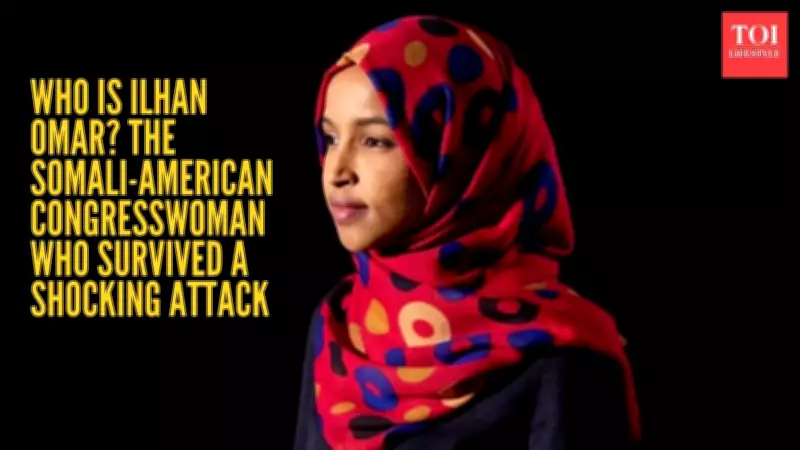
Congresswoman Ilhan Omar from Minnesota has once again captured national attention after being targeted in a public incident. During an event, she was sprayed with an unknown substance, though she emerged unharmed from the encounter. Law enforcement authorities swiftly responded, arresting the suspect identified as Anthony J. Kazmierczak, aged 55. However, the precise motivations behind his actions remain unclear and under investigation.
Omar's Defiant Response and Political Context
In the aftermath of the attack, Omar displayed remarkable resilience, drawing from her personal history. As quoted by The New York Times, she stated, “I’ve survived war. And I’m definitely going to survive intimidation and whatever these people think they can throw at me.” This statement underscores her determination in the face of adversity, a trait that has defined her political career.
Omar has established herself as a prominent figure in national politics, known for her strong progressive views. Her positions have frequently drawn criticism from right-wing politicians, including former President Donald Trump. Trump has singled her out on multiple occasions, with his supporters chanting phrases like “Send her back,” and he has made disparaging remarks about her, as reported by The New York Times. These attacks have often included false claims about her personal life and political stances, contributing to a polarized environment.

From Refugee to Congresswoman: A Journey of Resilience
Ilhan Omar's path to the United States Congress is a testament to perseverance. Born in Somalia in 1982, she fled her war-torn homeland as a child, seeking refuge. After spending time in a camp in Kenya, her family arrived in the United States in 1995, initially settling in Virginia before moving to Minneapolis. There, they found a welcoming Somali community, but Omar faced challenges growing up as a Muslim girl wearing a hijab.
She recalled instances of bullying, such as other children sticking gum on her headscarf and pushing her down stairs. Her father offered wise counsel that shaped her outlook: “Listen, these people who are doing all of these things to you, they’re not doing something to you because they dislike you. They are doing something to you because they feel threatened in some way by your existence.” This advice helped her navigate adversity and fueled her drive for public service.
Political Ascent and Progressive Advocacy
After completing her education at North Dakota State University, Omar returned to Minnesota to embark on her political journey. In 2017, she was elected to the state House of Representatives, and in 2019, she made history by becoming one of the first two Muslim women to serve in the United States Congress, alongside Rashida Tlaib of Michigan.
Omar ran on a progressive platform that included support for Medicare for All and L.G.B.T.Q. rights. She quickly rose to national prominence as a member of “the Squad,” a group of young Democratic lawmakers that includes figures like Alexandria Ocasio-Cortez. Her bold political stance and advocacy have made her a influential voice in progressive circles.
Controversial Positions and Ongoing Scrutiny
Omar's political career has not been without controversy. According to The New York Times, she has taken polarizing positions on issues related to Israel and Gaza. She supports the boycott of Israel and has accused its government of committing genocide in Gaza, allegations that Israel denies.
In 2019, she faced backlash after writing on social media that U.S. support for Israel was “all about the Benjamins.” Some Jewish groups criticized this comment for reinforcing harmful stereotypes, leading Omar to apologize. Supporters argue that she has been unfairly targeted due to her identity as a Muslim woman wearing a hijab in Congress.
Recently, Omar has faced increased political scrutiny. House Republicans have suggested investigating her connection to a Minnesota fraud case involving some members of the Somali community, who allegedly billed state agencies for services not provided. Trump used this scandal to criticize Somali Americans, including Omar, making inflammatory remarks about their origins.

Additionally, since 2024, the Justice Department has been reviewing Omar's finances, campaign spending, and interactions with a foreign citizen. No charges have been filed to date, and Omar has denied any wrongdoing, stating, “Years of ‘investigations’ have found nothing.” Many Somali Americans feel that their community's reputation has been negatively impacted by these controversies.