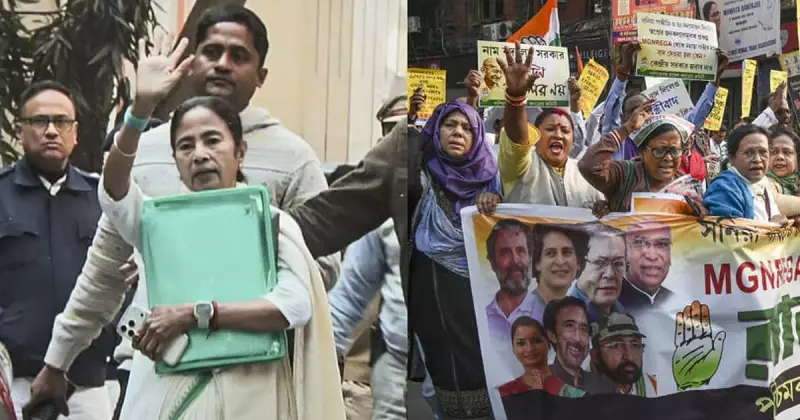
A major political and legal confrontation unfolded on Thursday, January 8, 2026, with two significant developments capturing national attention. In West Bengal, the Enforcement Directorate (ED) conducted searches at the Kolkata office of the Indian Political Action Committee (I-PAC), leading to a direct face-off with Chief Minister Mamata Banerjee. Simultaneously, the Karnataka government announced its decision to approach the Supreme Court to challenge the controversial VB-G RAM G Act.
Kolkata Raid: Mamata Banerjee's Confrontation with ED
The political temperature soared in Kolkata as ED officials carried out raids at the office of I-PAC, a prominent political consultancy firm known for its association with various parties. The searches, which began in the morning, are reportedly linked to an ongoing money laundering investigation.
Chief Minister Mamata Banerjee swiftly condemned the action, labeling it as a politically motivated move by the central government to harass and intimidate the opposition. She accused the ED of acting as a tool of the ruling party and vowed to resist what she called "undemocratic pressure." The Trinamool Congress cadre gathered outside the office, leading to a tense standoff with central agency officials and security personnel.

This incident marks a significant escalation in the ongoing tussle between the West Bengal government and central investigative agencies. The I-PAC office raid in Kolkata is seen as a direct challenge to the state's ruling establishment, potentially influencing the broader political landscape ahead of future elections.
Karnataka's Legal Challenge Against Central Act
In a parallel development, the Congress-led government in Karnataka declared its intention to move the Supreme Court against the VB-G RAM G Act. The specifics of this Act, as implied by the shorthand, suggest it is a central legislation perceived by the state as infringing upon its rights or causing significant grievance.
The state cabinet, after a meeting, resolved to file a petition in the apex court, arguing that the Act is unconstitutional and undermines the federal structure of the country. This legal step underscores the growing list of disputes between opposition-ruled states and the central government over legislative matters.
Karnataka's decision to seek judicial intervention sets the stage for a major constitutional debate. The move is likely to be watched closely by other non-BJP ruled states that have expressed similar concerns about central overreach.
Broader Implications and Political Fallout
The events of January 8 highlight the deepening political fissures in the country. The raid in Kolkata and the planned legal battle from Karnataka represent two fronts of opposition resistance against the central government's authority.
Analysts suggest that the ED action against I-PAC could be aimed at dismantling the electoral strategy backbone of certain parties, while the challenge to the central Act reflects a struggle for state autonomy. Together, they signal a period of intensified political and legal warfare.
The outcomes of these confrontations will have lasting implications for federal relations, the use of central agencies, and the strategies employed by political parties as the nation progresses further into 2026.