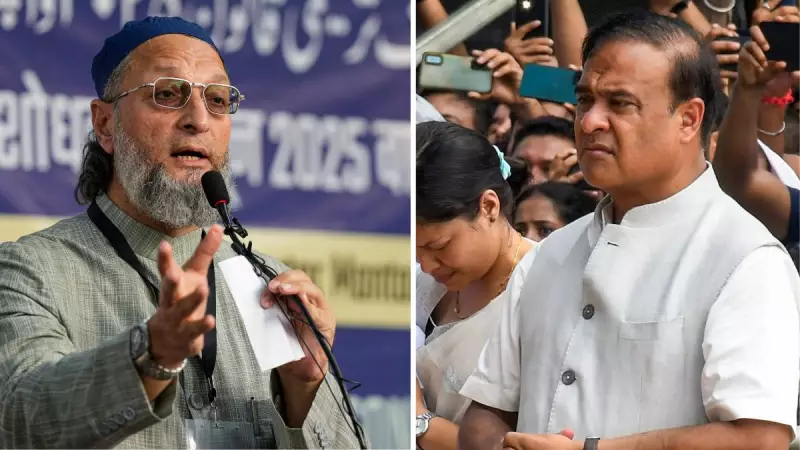
A major political controversy has erupted following a sharp exchange of words between Assam Chief Minister Himanta Biswa Sarma and All India Majlis-e-Ittehadul Muslimeen (AIMIM) chief Asaduddin Owaisi. The war of words, which intensified on January 11, 2026, centers around a remark made by Owaisi concerning the possibility of a hijab-clad Prime Minister in India.
The Spark: Owaisi's Remark on a Hijab-Clad PM
The controversy began when Asaduddin Owaisi, during a public address, commented on the secular fabric of India. He stated that the country's constitution and secular ethos do not prevent a woman wearing a hijab from becoming the Prime Minister. This remark was intended to highlight the inclusive nature of Indian democracy. However, it quickly drew a fierce and personal rebuttal from a senior Bharatiya Janata Party (BJP) leader.
Assam Chief Minister Himanta Biswa Sarma launched a direct attack on Owaisi, accusing him of harboring a "Pakistan-like mindset." Sarma argued that Owaisi's comment was divisive and aimed at importing a foreign brand of identity politics into India's secular polity. He emphasized that in India, leadership is based on merit and service, not religious attire or symbols. This strong condemnation set the stage for a heated back-and-forth between the two prominent politicians.

Escalation and the 'Pakistan Mindset' Accusation
Responding to Sarma's sharp criticism, Asaduddin Owaisi did not hold back. He countered by questioning the Assam CM's understanding of secularism and the Indian constitution. Owaisi defended his original statement, asserting that it was a simple affirmation of constitutional rights and gender equality. He accused Sarma and his ideological camp of being unable to digest the idea of a Muslim woman in a position of supreme power, which he claimed revealed their own majoritarian prejudices.
The debate intensified as both leaders traded barbs in the media. Sarma doubled down on his "Pakistan mindset" allegation, suggesting that the demand for identity-based political representation, as highlighted by the hijab remark, mirrors the communal politics that led to the partition of the subcontinent. Owaisi, in turn, labeled Sarma's comments as "hate speech" designed to polarize the electorate and distract from governance issues.
Broader Implications for Political Discourse
This public spat has transcended a mere personal clash, sparking a wider debate on several critical issues in Indian politics. The core of the disagreement touches upon the interpretation of secularism, the place of religious identity in public life, and the boundaries of political rhetoric. Political analysts suggest that this incident is part of a larger, ongoing narrative battle between the BJP's vision of cultural nationalism and the opposition's emphasis on pluralistic identity politics.
The timing of the controversy is also significant, as it adds fuel to the already charged political atmosphere in the country. It has mobilized supporters on both sides, leading to heated discussions on social media and news platforms. The incident raises questions about whether political debates are focusing on substantive issues of development and welfare or getting mired in symbolic and polarizing arguments.
Furthermore, the exchange has brought the issue of women's rights and religious freedom back into the spotlight. While one side views the hijab as a matter of personal choice and faith that should not be a political barrier, the other sees its highlighting in political discourse as an unnecessary communalization of the public sphere. As the war of words continues, it remains to be seen how this controversy will influence public opinion and the strategies of political parties in the days to come.