

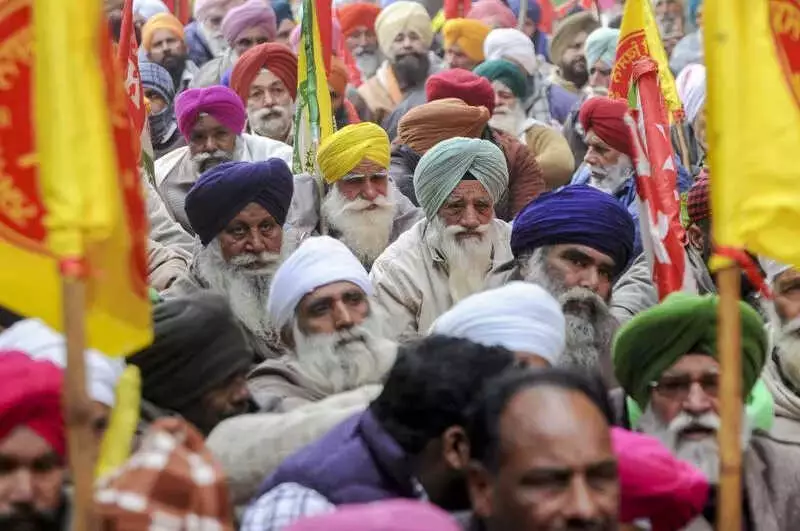
Farmers, labourers, and trade organisations held coordinated protests across Punjab on Thursday. They answered a call from the Sanyukt Kisan Morcha (SKM) to oppose what they term as harmful government policies.
Widespread Discontent Fuels Statewide Action
The groups observed January 16 as 'All India Resistance Day'. Their primary targets were several legislative moves by the Union government. Protesters voiced strong opposition to the Viksit Bharat Guarantee for Rozgar and Ajeevika Mission (Gramin), or VB-GRAMG. They also demonstrated against the Electricity (Amendment) Bill, the Seeds Bill, and the four Labour Codes.
Participants stated their actions stem from deep frustration. They accuse the government of pushing pro-corporate and anti-farmer reforms. They view these policies as part of a neoliberal agenda that hurts rural and working communities.

Broken Promises on MSP and Electricity
Protesters highlighted a history of unfulfilled commitments. They pointed to a key agreement from December 9, 2021. After a year-long farmers' struggle, the central government promised to form a committee. This committee was meant to address Minimum Support Price (MSP) issues and rising farmer debt.
Farmers claim the government failed to keep this promise. Since that agreement, they report no increase in MSP. Crop prices, they say, remain 20% to 30% below the levels recommended by the M S Swaminathan formula. Meanwhile, input costs like fertilisers have risen sharply.
Guaranteed procurement has also failed, according to the protesters. This failure means most crops now sell in the market for 20% to 40% less than the declared MSP.
The 2021 agreement also included a pledge on electricity. The government promised not to impose the Electricity Amendment Bill without consulting farmers. Despite this, the government introduced the New Electricity Bill 2025. Farmers say this bill mandates higher, uniform tariffs for all users. It removes cross-subsidies that benefited weaker sections, including agriculture. It also imposes pre-paid smart meters.
Condemnation of Labour Codes and MGNREGA Replacement
The SKM issued a strong statement against the VB-GRAMG Act 2025. They call it a disastrous replacement for the Mahatma Gandhi National Rural Employment Guarantee Act (MGNREGA).
"We strongly protest the repealing of MGNREGA," the SKM stated. "The new act takes away the right to work and a job guarantee for at least 100 days. It withdraws the 'Work on Demand' provision. It also drastically cuts allocations, contrary to false claims of 125 days' work per year."
The statement added that the VB-GRAMG Act places an additional financial burden on state governments, estimated at 40% of the cost.
The protestors also condemned the four Labour Codes. They described them as a direct attack on the country's working class.
"These codes take away rights achieved through decades of struggle," the SKM stated. "They undermine the right to form unions, secure minimum living wages, ensure secure employment, guarantee eight hours of work, and provide social security and workplace safety. This pushes the working class into servitude to corporate capital."
A Pledge for Continued Struggle
The farmers, workers, and agricultural labourers have made a firm commitment. They pledge to build consistent and united pan-India struggles. Their goal is clear and multi-faceted.
They demand the Union government repeal four key pieces of legislation:
- The Seeds Bill 2025
- The Electricity Bill 2025
- The VB-GRAMG Act 2025
- The four Labour Codes
Furthermore, they aim to force the government to enact new laws. Their demands include:
- A law guaranteeing MSP at the C2+50% formula with guaranteed procurement for all crops.
- A comprehensive loan waiver for farmers.
- An end to peasant and daily worker suicides and rural indebtedness.
- Full implementation of the Land Acquisition, Rehabilitation and Resettlement (LARR) Act, 2013.
- Protection of the federal rights of states.
The protests in Bathinda and across Punjab mark a significant escalation in the ongoing dialogue between agricultural communities and the central government. The day of resistance underscores the deep-seated economic anxieties in rural India.






