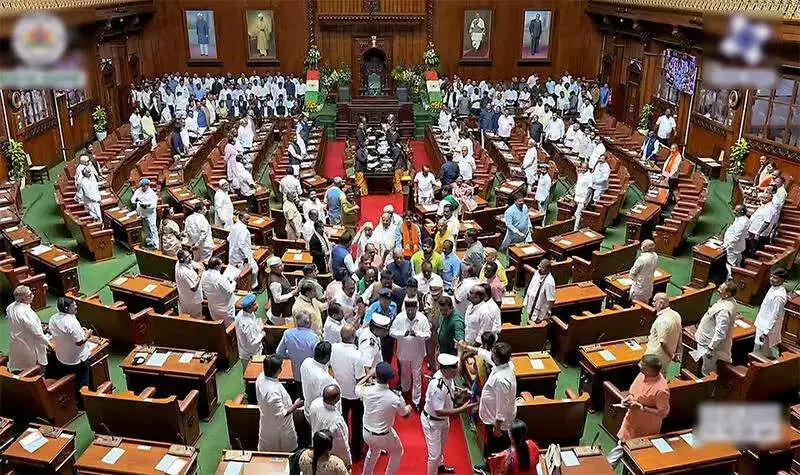
Constitutional Clash in Karnataka: Experts Divided Over Governor's Truncated Address
In Bengaluru, constitutional and legal experts have expressed sharply divergent views regarding the controversial stand taken by Governor Thaawar Chand Gehlot and the subsequent objections raised by the state government. The dispute centers on his brief appearance and significantly shortened address delivered to the joint session of the Karnataka legislature on Thursday, sparking a heated debate over constitutional propriety and gubernatorial duties.
Serious Constitutional Lapse Alleged
Prof Ravivarma Kumar, a former advocate general of Karnataka, has characterized the governor's conduct as a direct affront to Article 176 of the Constitution of India. He emphasized that the governor has a clear constitutional duty to read the entire speech prepared by the council of ministers, describing this requirement as mandatory rather than optional.
"His conduct constitutes a serious constitutional lapse and a fundamental breach of the oath he solemnly took," Kumar stated firmly. "The President of India must consider withdrawing him from office for failing to follow the explicit advice of the elected cabinet."

Alternative Legal Interpretations Emerge
However, AS Ponnanna, the legal adviser to the chief minister, offered a different perspective. He suggested that since Governor Gehlot did appear in the legislative house and read a portion of the prepared speech, it could be interpreted that the speech was effectively delivered in full. Ponnanna indicated that this contentious issue would likely be thoroughly debated during the upcoming motion of thanks, potentially leading to an appropriate legislative resolution.
Ashok Haranahalli, another former advocate general, defended the governor's actions, arguing that he had fulfilled his constitutional duty merely by attending the session and delivering a formal speech, regardless of its length. "Legal complications arise only when a governor outright refuses to attend or deliver any speech whatsoever," Haranahalli explained. "If the government has substantive concerns about the address, they possess the parliamentary mechanism to debate it within the house and reach a democratic decision."
Procedural Nuances and National Anthem Protocol
Uday Holla, also a former advocate general, addressed the specific procedural aspect of the national anthem. He clarified that no existing rule explicitly requires the governor to wait for the national anthem to conclude before departing. "Only if the governor were to walk out deliberately while the national anthem is being played would such an action be considered disrespectful," Holla noted, providing important context to the procedural debate.
Former Legislative Leaders Weigh In
Former chairpersons of the Karnataka legislature added further layers to this constitutional discussion with their own contrasting opinions.
KB Koliwad, former speaker and Congress MLA, asserted that if the state government were to approach the Supreme Court, there exists a genuine possibility of a judicial decision against the governor's actions. "The Constitution unequivocally states that the governor cannot alter or modify the speech prepared by the elected government," Koliwad argued. "Since he delivered his own abbreviated version, this action stands in direct contravention of constitutional provisions."
In contrast, Vishweshwar Hegde Kageri, BJP MP and former speaker, highlighted the ambiguity surrounding whether the governor must read the complete speech or merely a part of it. "This constitutional issue remains actively debated without clear resolution," Kageri observed. "However, the confrontational attitude displayed by senior Congress functionaries, including BK Hariprasad and others, has unnecessarily politicized the matter. How can elected representatives justify shouting slogans against the constitutional office of the governor?"

Calls for Constitutional Clarification
BL Shankar, former chairperson of the Karnataka legislative council, proposed a more structural solution to prevent future controversies. He advocated for amending the Constitution itself to establish unambiguous clarity regarding whether governors must read the entire speech prepared by state governments or if abbreviated versions maintain constitutional validity.
This constitutional debate in Bengaluru reflects deeper tensions between elected state governments and appointed gubernatorial offices, highlighting the ongoing need for precise constitutional interpretation in India's federal democratic structure.