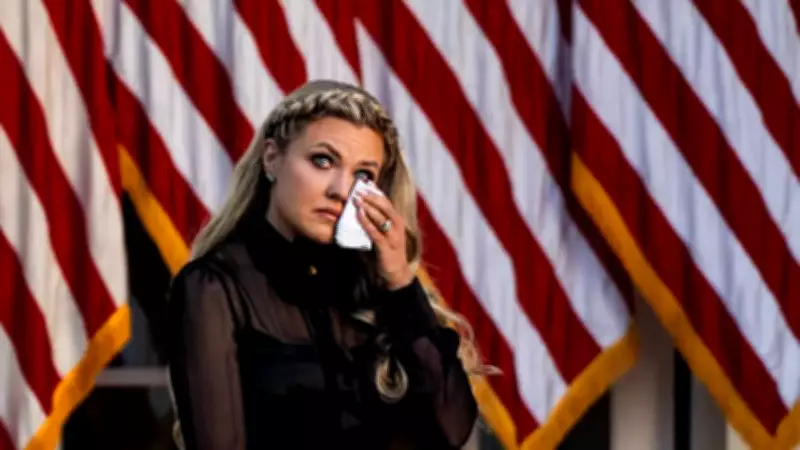
Erika Kirk: The Widow Who Defied Tradition and Became a Political Force
Widowhood typically enters global conversations during moments of collective tragedy—pandemics, wars, royal funerals, or the passing of iconic public figures. In recent years, discussions about widows emerged from the shadows of the Israel-Hamas conflict, the Russia-Ukraine war, and the COVID-19 pandemic. The language surrounding these women was uniformly one of grief, loss, and sympathy, with governments pledging support and communities offering condolences.
However, over the past year, the global gaze has shifted dramatically toward a different kind of widow—one not draped in quiet despair but illuminated by spotlight and strategy. This widow has become the subject of intense scrutiny, with conversations focusing not on her loss but on her gains, not on regret but on happiness, and not on sympathy but on indifference, all serving as reminders that the world is watching and judging. That woman is Erika Kirk, widow of Charlie Kirk, founder of the conservative youth organization Turning Point USA.
From Tragedy to the Limelight
Since the assassination of her husband on September 10, 2025, at Utah Valley University, Erika Kirk has been thrust into an unprecedented public spotlight. While the illumination focuses on her, public attention remains fixated on the shadow behind her. The question echoing across media platforms transcends simple identity—it probes what kind of widow she has chosen to become.

Born Erika Frantzve in November 1988 in Scottsdale, Arizona, she was raised by her mother in a Catholic household following her parents' divorce. A political science graduate and former NCAA women's basketball player, Erika's early life blended discipline, ambition, and visibility long before she entered the political arena.
Before Charlie: A Life of Ambition
Before meeting Charlie Kirk, Erika was building her own path like countless other ambitious women. She began her career as a model and won Miss Arizona USA in 2012. At just 17, she established the non-profit Everyday Heroes to promote existing charitable foundations in her community.
A year after meeting Kirk, she launched a faith-based fashion brand called Proclaim and created her own religious podcast, Midweek Rise Up. She even guest-starred in an episode of the Bravo reality series 'Summer House' in 2019. Before embracing the role of conservative tradwife and assuming leadership of TPUSA, Erika worked as a real estate agent in New York with The Corcoran Group, founded by Shark Tank investor Barbara Corcoran.
The Kirk Partnership and Its Aftermath
At 37, Erika Kirk now serves as CEO and chairperson of TPUSA, the conservative youth organization co-founded by her slain activist husband. The couple met in 2018 when Charlie interviewed Erika for a position at Turning Point USA. Their relationship blossomed over a burger restaurant meeting in New York, where Charlie found her "beautiful, smart, elegant and Christ-like," leading to their marriage in 2021.
Together, they crafted the image of a modern conservative family—faith-driven, politically active, homeschooling parents of two. This carefully constructed image would fracture dramatically in 2025.
After Charlie: A New Public Persona Emerges
The world first saw Erika Kirk after her husband's death in a video filmed in the studio where he recorded his podcast, The Charlie Kirk Show. "You have no idea of the fire that you have ignited within this wife, the cries of this widow will echo around the world like a battle cry," she declared before describing Kirk as the "perfect" husband and father.
A week later, she was announced as TPUSA's new CEO. Her public appearance on September 21, 2025, at a memorial service at State Farm Stadium in Arizona included shocking fireworks, her forgiveness of her husband's murderer Tyler Robinson, and a hug with former US President Donald Trump.
Over the past year, Erika has embarked on tours, given interviews, and hosted events as head of the right-wing organization that has been closely aligned with Trump since 2016. She has firmly positioned herself as a political force rather than a grieving recluse, creating what many perceive as a significant rupture from traditional expectations.

Widowhood: The Traditional Script Women Were Meant to Follow
Gender roles have historically predetermined much of life's trajectory for both men and women. From childhood to partnership, roles and responsibilities follow similar patterns, with timing being the primary variable. While some follow this script entirely, others encounter unexpected deviations. Widowhood represents one such deviation—an unanticipated stage for which few are prepared, not because they lack direction but because they struggle to conform to society's predetermined path.
Across cultures and centuries, widowhood has come with specific choreography. Victorian women donned black, endured two years of isolation and mourning, left home only for church, and awaited their husband's will to determine their financial fate. In South Asia, particularly India, widows wore white clothing, shaved their heads, and depended on their husbands' relatives. Until the 19th century, this sometimes included the practice of Sati, where widows would immolate themselves on their husband's pyre.
African widows observed mourning periods involving hair cutting, name changes, cleansing rituals, and in some cultures, marriage to their husband's younger brother. Islamic women practiced Iddah, a waiting period of four months and ten days before considering remarriage. Widowhood has rarely been neutral—it demands silence, modesty, and containment. Erika Kirk appears to have rejected this traditional script entirely.
Erika Kirk's Unconventional Brand of Widowhood
Critics describe her approach as theatrical—bold eyeliner replacing the traditional widow's veil, speeches oscillating between tears and laughter, high-energy events instead of hushed remembrance. From the beginning, Erika has teetered away from conventional guidelines.
Previously, she presented herself as an ideal housewife who claimed to "love submitting to Charlie," becoming an idol for conservative households influenced by TPUSA. She joined her husband on tours, homeschooled their children, and portrayed the perfect conservative American family following God's path.
Following her husband's death, however, Erika stopped ticking societal boxes. Rather than weeping at home and receiving mourning visitors, she was on a phone call with TPUSA employees just 15 days after the assassination, assuring them that everything was "stable and safe." Unlike most political figures, she wasn't ushered into leadership by established figures—she took the helm herself.
Instead of being seen protecting her children or supporting her in-laws, she appears on stage both crying and laughing, preaching Christianity to American youth. For all this, she enjoys the backing of the President and Vice President of the United States, leading an organization already positioned for success while ensuring the world remains watching.
The Modern Woman Paradox
At the heart of Erika Kirk's media tussle lies her gender. Her behavior seemingly contradicts the organization's aspirations for women. According to a Southern Poverty Law Center report, at a TPUSA conference for young women before Kirk's death, both he and Erika emphasized the importance of women choosing families over careers.
Erika told the audience, "I don't want you to be chasing a paycheck and a title and a corner office and sacrifice such a short window" to have children, while Charlie advised young women to seek an "MRS degree"—finding a husband—as their primary college goal.
Yet Erika's circumstances have changed dramatically. As a widow who has explored numerous careers without settling, her stable income now comes from TPUSA and media appearances. When asked about balancing her CEO role with motherhood, she stated there is "no such thing as balance" and acknowledged, "There is really no blueprint for what I'm going through. It's really a one-of-one type of situation."
Her 2014 audition for 'The Amazing Race' with then-boyfriend JT Massey shocked the internet, though such experiences are common for many. Critics argue she hasn't practiced what she preaches, but who hasn't experienced life trajectory changes?
The Gilded Echo: Parallels with Theresa Fair Oelrich
Conspiracy theories abound regarding Erika Kirk, from allegations of plotting her husband's murder to critiques of her "demonic" stare and "fake" crying. This scrutiny invites comparison to Theresa Fair Oelrich, one of the most famous American widows of the Gilded Age.
Born in 1871 to mining wealth, Oelrich approached social supremacy with engineering precision. She married Herman Oelrichs in 1890, merging new money with old prestige. At Newport, she manipulated her way into the triumvirate controlling access to American high society, hosting legendary parties like the 1904 Bal Blanc featuring white swans and illuminated ships.
Like Oelrich, Erika Kirk understands that visibility is currency in elite circles. She has positioned herself within America's modern triumvirate alongside Melania Trump and Usha Vance, controlling access to contemporary elite circles. Her fireworks and emotional displays serve as performances in her metaphorical ballroom, keeping America engaged.
Widowhood in the Digital Age
Today, widowhood lacks a universal blueprint. In our hyper-digital era, grief unfolds under algorithmic scrutiny—tears replayed, outfits dissected, body language analyzed. The internet doesn't merely observe widows; it audits them. This explains why Erika Kirk provokes such intensity: she hasn't become invisible, receded, or dimmed. She has stepped forward.
What example does she set? To conservative purists, she complicates narratives of submission and domestic priority. To feminists skeptical of her politics, she represents power built atop structures they oppose. To observers fatigued by performative outrage, she may simply be a woman navigating grief and survival in real time.
Perhaps what unsettles the world most is this: she is neither saint nor villain, just a widow who refused to disappear. In an age where women are still expected to shrink in sorrow, that alone proves enough to ignite fireworks of controversy and conversation.