In a strong stance against the government's recent move, Congress President Mallikarjun Kharge has pledged that his party will vigorously oppose the renaming of the Mahatma Gandhi National Rural Employment Guarantee Act (MGNREGA) during the upcoming Budget session. The scheme has been rebranded as the Viksit Bharat – Guarantee for Rozgar Ajeevika Mission (Gramin), or VB-G RAM G, sparking significant political controversy.
Kharge's Commitment to Preserve Gandhi's Legacy
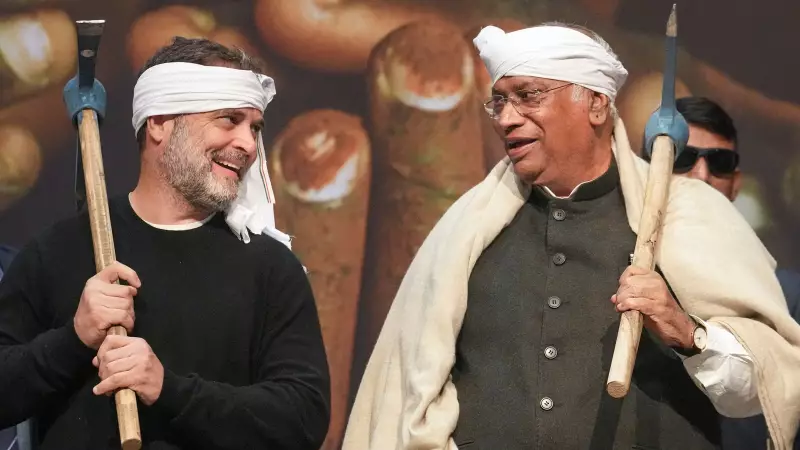
Speaking at the National MGNREGA Workers' Convention in New Delhi, organized by the Rachnatmak Congress, Kharge emphasized that the fight against this change will be a prolonged one. He stated, "Our fight is going to be a long one. Satyagraha or shouting slogans won't help in this fight. Till they don't repeal the new laws and bring MGNREGA back, we will continue our struggle." Kharge further asserted that the name alteration represents a deliberate effort to remove Mahatma Gandhi's name from public consciousness and undermine the concept of Gram Swaraj, which advocates for village self-governance.
Rahul Gandhi Draws Parallels with Farm Laws
Meanwhile, Leader of the Opposition in the Lok Sabha, Rahul Gandhi, drew sharp comparisons between the repeal of MGNREGA and the contentious farm laws introduced by the Modi government. He claimed that the objectives behind both moves are strikingly similar, labeling them as "three black farm laws" in reference to the earlier agricultural reforms. Gandhi urged the poor and marginalized sections of society to unite against the VB-G RAM G Act, highlighting that MGNREGA was originally designed to empower the underprivileged by guaranteeing their right to work through Panchayati Raj institutions.

Gandhi elaborated, "The thinking was to provide work to those who need it. This scheme was to be run through the third tier of government – Panchayati Raj. The word rights was important. All poor people had the right to work under MGNREGA and PM Modi-BJP wants to finish that concept." He also alleged that the new legislation would centralize decision-making, allowing the Centre to dictate work allocations and fund distributions, with preferential treatment for BJP-ruled states.
Allegations of Favoring Corporates and Contractors
In his address, Rahul Gandhi made further accusations, suggesting that the BJP's model aims to concentrate assets in the hands of a few wealthy individuals, thereby making the poor dependent on industrialists like Adani and Ambani. He charged, "They want assets to be in a few hands so that the poor people are dependent on Adani-Ambani, that is their model of India." Additionally, Gandhi expressed concerns that under the new law, benefits previously directed to workers would now be diverted to contractors and bureaucratic channels, eroding the grassroots empowerment that MGNREGA once fostered.
Symbolic Protests and Nationwide Campaign
The convention saw participation from workers across India, who brought fistfuls of soil from their work sites as a symbolic gesture, placing them in plants in the presence of Congress leaders. This act underscored their deep connection to the land and the scheme that has provided them with livelihood opportunities. Earlier, on January 10, the Congress party launched the 'MGNREGA Bachao Sangram' – a 45-day nationwide campaign aimed at opposing the repeal of the UPA-era MGNREGA and advocating for its restoration as a rights-based law.
The Opposition's demands are clear: they seek the withdrawal of the VB-G RAM G Act and the reinstatement of MGNREGA in its original form, which includes the right to work and the authority of panchayats. As the Budget session approaches, scheduled to begin on January 28, 2026, this issue is poised to become a focal point of political debate, reflecting broader tensions over rural development and historical legacy in India.