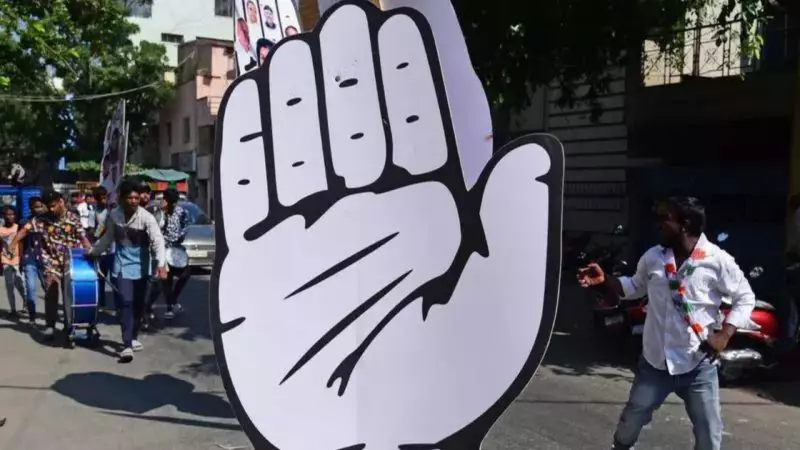
The recent suspension of twelve Congress councillors in Ambernath, Maharashtra, for alleged anti-party activities, and their swift defection to the Bharatiya Janata Party (BJP) the very next day, sent shockwaves through political circles. However, a closer look reveals this episode is merely the latest chapter in a long, unfolding story of the Indian National Congress's steady decline, where party loyalty is increasingly sacrificed at the altar of political survival.
The Ambernath Blueprint: Numbers Trump Ideology
On the surface, Ambernath is a small municipal council in Maharashtra's Thane district. Yet, it became a microcosm of modern Indian political realpolitik. The local election yielded a fractured mandate, with the Eknath Shinde-led Shiv Sena emerging as the single largest party but lacking a majority. In a post-poll maneuver driven purely by arithmetic, the BJP, Congress, and the Nationalist Congress Party (NCP) formed an alliance called the Ambernath Vikas Aghadi. Their shared goal was not ideology but to keep the Shiv Sena out of power.
This arrangement created immediate contradictions. For the Congress, aligning with the BJP locally clashed with its national stance as the principal opposition. The party leadership chose discipline, suspending its 12 councillors. But in today's climate, suspension often acts as an invitation, not a deterrent. The councillors promptly crossed over to the BJP, turning their punishment into a fresh opportunity. The subsequent chaos—with a BJP minister questioning the induction and NCP councillors switching sides again—highlighted the extreme fluidity of power at even the most local levels.

A Decade of Decline: Mapping the Congress Exodus
The Ambernath incident is a symptom of a far larger, systemic issue. The Congress's parliamentary trajectory tells a stark story. Between 1999 and 2009, the party was a central pillar, winning between 114 and 206 Lok Sabha seats. The collapse came in 2014, when its tally plummeted to 44 seats. Marginal recoveries to 52 in 2019 and about 99 in 2024 have done little to reverse the perception of an organisation in deep crisis.
This crisis is characterised by a steady erosion of internal authority. Defections are no longer isolated scandals but predictable, coordinated events. An analysis by the Association for Democratic Reforms (ADR) covering 2014 to 2021 provides damning evidence. The study found that 222 Congress candidates left the party to join rivals, the highest for any party. At the legislative level, 177 out of 500 MPs and MLAs who switched parties were from the Congress, accounting for nearly 35% of all defectors. In contrast, the BJP was the biggest beneficiary, absorbing 173 MPs and MLAs.
The exodus has been a state-by-state unravelling, accelerating after 2014 and peaking between 2017 and 2021. It follows a familiar rhythm: electoral setback, internal leadership dispute, prolonged indecision from the party high command, and finally, a coordinated exit.
From 'Aaya Ram, Gaya Ram' to Engineered Migration
Defections are not new to India. The phrase "Aaya Ram, Gaya Ram" entered the political lexicon in the 1960s, mocking frequent party switches. The Anti-Defection Law of 1985 was enacted to curb this. Initially effective, it slowed impulsive individual defections. However, politics adapted. Politicians and parties became more strategic, engineering defections through group resignations and legal loopholes. This transformed opportunistic switching into a structured, numbers-driven process of post-election government formation, where mandates often matter less than managed majorities.
The Internal Disconnect and Leadership Paralysis
The root of the Congress's vulnerability lies in a growing chasm between its leadership and its ranks. This was crystallised in a letter by former Odisha MLA Mohammed Moquim to Sonia Gandhi, where he called for "open-heart surgery" within the party. He highlighted a disconnect with grassroots workers and noted he hadn't met Rahul Gandhi in nearly three years—a sentiment echoing among many cadres who feel their voices are unheard.

Similar tensions have surfaced in states like Bihar, Karnataka, Rajasthan, and Madhya Pradesh, where prolonged leadership tussles and perceived indecision have cost the party electorally. The Congress has transitioned from a party of abundant internal debate to one of precarity, where competing lobbies create paralysis and senior leaders exit citing unresolved grievances.
Broader Implications: A Stress Test for Democracy
The normalisation of defections has consequences that extend beyond the fate of a single party. When municipal councils and state assemblies—the nurseries of democratic leadership—become arenas for transactional politics, it corrodes public trust. Governments change without voters being consulted, making mandates seem provisional. Over time, this breeds cynicism not just toward political parties but toward the representative process itself.
The Anti-Defection Law, meant to stabilise governance, now often provides the legal framework within which these engineered exits occur. It underscores a hard truth: procedural rules cannot substitute for organisational strength, internal cohesion, and a compelling political vision. The pressing question for Indian politics is no longer why leaders leave the Congress, but what remains to hold the party—and by extension, a robust opposition—together.