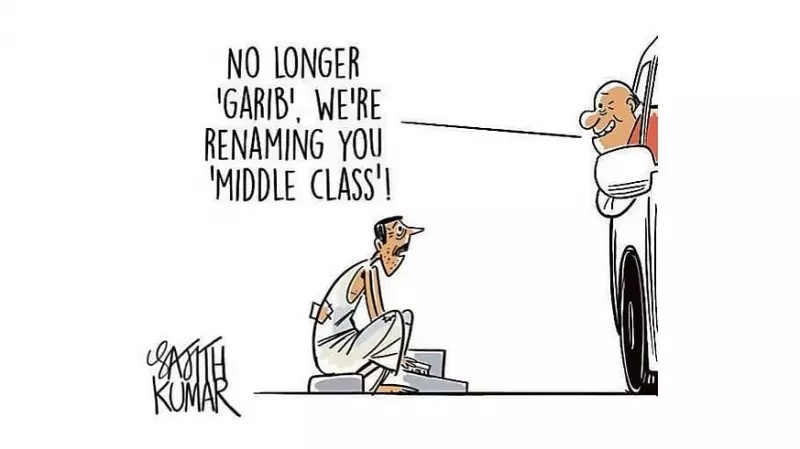
A recent political cartoon published by Deccan Herald has ignited a fresh wave of discussion and debate surrounding the official definition of poverty in India. The satirical artwork, pointedly titled, questions the evolving narrative of who qualifies as 'garib' or poor in the contemporary Indian context.
The Cartoon's Stark Message
The cartoon serves as a powerful visual commentary on the perceived shifting of goalposts when it comes to identifying India's impoverished population. Through its imagery and caption, it implies a concerning trend: the benchmark for being considered poor is being raised so high that a significant section of the struggling population risks being statistically invisible. This artistic critique taps into a long-standing and complex debate among economists, policymakers, and social activists about the adequacy of existing poverty lines and the methodologies used to measure deprivation.
The core issue highlighted is not just about numbers on a spreadsheet but about the real-world consequences of such definitions. Government schemes, subsidies, and welfare benefits are often directly tied to these official poverty thresholds. Therefore, a change in definition can potentially exclude millions from crucial safety nets designed to provide food security, housing, healthcare, and financial assistance.

Context: The Ever-Evolving Poverty Line Debate
India's official poverty line has been a subject of intense controversy for decades. Critics have often argued that the monetary value set is too low to guarantee a basic standard of living, especially in urban areas with higher costs. The cartoon reflects the public skepticism that arises with any governmental reassessment of poverty metrics. There is a widespread concern that such revisions might be politically motivated, aimed at presenting a rosier picture of economic progress by simply reclassifying the poor rather than through substantive upliftment.
This discussion gains further urgency in light of various economic surveys and reports that point to income inequality, joblessness, and rural distress. The satirical piece challenges viewers to look beyond headline-grabbing GDP figures and consider the ground reality for the common citizen. It asks a fundamental question: if the definition of 'garib' keeps changing, who is ultimately responsible for ensuring that the most vulnerable are not left behind in India's growth story?
Broader Implications and Public Reaction
The publication of this cartoon has resonated with a segment of the audience that feels economic narratives are increasingly disconnected from their daily struggles. Political cartoons, as a form of journalism, play a vital role in holding power to account and simplifying complex socio-economic issues into digestible, thought-provoking content. This particular instance has successfully refocused attention on the human element behind statistical definitions.
The debate it sparks touches several critical areas:
- Policy Efficacy: Are welfare programs reaching the truly needy if the beneficiary list is based on a potentially flawed definition?
- Transparency: Calls for greater clarity and inclusivity in the process of determining who is poor.
- Accountability: It underscores the media's role in questioning official narratives and fostering public discourse.
While the cartoon does not provide solutions, its value lies in its ability to provoke critical thinking. It serves as a cultural checkpoint, reminding society and its leaders that the fight against poverty is not merely a technical exercise of adjusting formulas but a moral imperative to recognize and address human suffering. The lingering question it leaves is whether India's economic policies are designed to genuinely eradicate poverty or just to manage its statistical appearance.