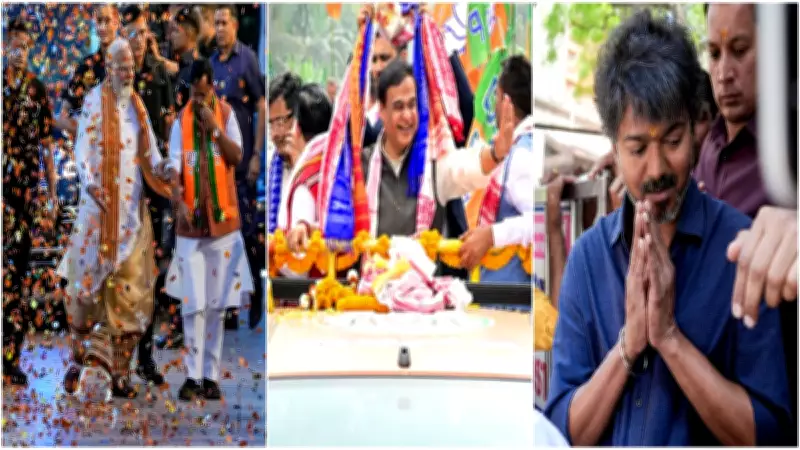
The 2026 assembly election results have brought significant political shifts across several Indian states. The Bharatiya Janata Party (BJP) achieved a landslide victory in West Bengal, sweeping the polls and unseating the incumbent Trinamool Congress (TMC) government. In Assam, the BJP retained power with a comfortable majority, continuing its governance in the northeastern state.
Tamil Nadu: A Stunning Victory for TVK
In Tamil Nadu, the Tamilaga Vettri Kazhagam (TVK) delivered a stunning performance, defeating the ruling Dravida Munnetra Kazhagam (DMK) and securing a clear majority. This marks a major political realignment in the state, as TVK's campaign resonated with voters seeking change.
Kerala: UDF Returns to Power
The United Democratic Front (UDF) staged a strong comeback in Kerala, ousting the Left Democratic Front (LDF) government. The UDF's victory is attributed to a coalition of Congress-led parties and a focus on development and welfare issues.

Puducherry: NDA Holds Ground
In Puducherry, the National Democratic Alliance (NDA) managed to retain power, albeit with a reduced majority. The alliance faced stiff competition from regional parties but ultimately secured enough seats to form the government.
Key Takeaways from the 2026 Assembly Elections
- BJP's Expansion: The party's sweep in West Bengal and retention in Assam underscore its growing footprint in eastern and northeastern India.
- Regional Resurgence: TVK's victory in Tamil Nadu highlights the enduring appeal of regional parties when they effectively channel local aspirations.
- Coalition Dynamics: UDF's win in Kerala demonstrates the effectiveness of pre-poll alliances in multi-cornered contests.
The results are expected to have implications for national politics, with the BJP strengthening its position ahead of the 2029 general elections. Meanwhile, opposition parties will need to reassess their strategies to counter the BJP's electoral machinery.