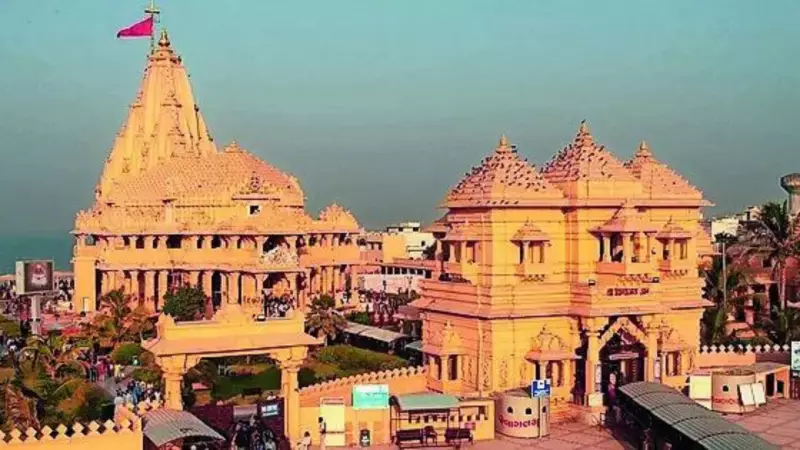
Ahead of Prime Minister Narendra Modi's launch of the year-long 'Somnath Swabhiman Parv' on January 11, the Bharatiya Janata Party (BJP) has launched a sharp political attack on the Congress. The party has accused India's first Prime Minister, Jawaharlal Nehru, of harbouring hatred towards the revered Somnath deity and opposing its reconstruction post-independence.
BJP's Allegations Based on Historical Letters
At a press conference in New Delhi, BJP spokesperson and Rajya Sabha MP Sudhanshu Trivedi presented letters written by Nehru to substantiate the party's claims. Trivedi alleged that Nehru believed the temple's reconstruction and the association of Congress stalwarts like then-President Rajendra Prasad with it would harm India's global image.
Trivedi stated that Nehru wrote over 17 letters questioning the need for the temple's rebuilding, addressing the then president, vice president, cabinet ministers, and chief ministers. He also allegedly instructed public broadcasters to minimise coverage of the event.

The BJP spokesperson highlighted a particular letter where Nehru addressed his Pakistani counterpart, Liaquat Ali Khan, as "my dear nawabzada" to protest false reports in Pakistan about the temple's construction. Trivedi contrasted this with Nehru's alleged failure to robustly defend India's civilisational memory.
Nehru's "Appeasement" vs. Patel's "Resolve"
Trivedi further accused Nehru of pursuing "blind appeasement politics" by repeatedly opposing President Rajendra Prasad's association with the temple's inauguration. He claimed Nehru even wrote to India's ambassador in China to downplay the temple's significance, ostensibly to avoid any adverse reaction from Chinese leader Mao Zedong.
"Nehru prioritised external appeasement over internal self-confidence," Trivedi alleged. He made a striking comparison, saying, "Somnath was plundered by Mahmud Ghazni and Khilji in the past, but in independent India, Pandit Nehru harboured the greatest hatred towards Lord Somnath."
The BJP framed this historical critique as a matter of principle, not a personal attack. "Our opposition to Nehru is not personal but on principles. His letters underline how scary and dangerous his ideas were. We are not tarnishing his image. We are merely unmasking it as Congress continues to follow the same principle," Trivedi asserted.
PM Modi's Visit and the Grand Festival
The political controversy erupts just before Prime Minister Modi's scheduled visit to the Somnath Temple in Gujarat on January 11. The date holds dual significance: it marks 1,000 years since Mahmud Ghazni's attack on the temple in 1026 AD, and it completes 75 years of Sardar Vallabhbhai Patel's historic resolve to rebuild the shrine.
During his visit, PM Modi will offer prayers at the temple, pay tributes at the statue of Sardar Patel outside its precincts, attend a roadshow, and address a large public gathering. He will also attend a 'Shaurya Yatra' dedicated to those who died defending the temple from invaders across centuries.
Gujarat minister Jitu Vaghani, highlighting the festival's attractions, announced a mega drone show featuring 3,000 drones—the largest of its kind—to depict Somnath's history and grandeur in the night sky. "To mark this rare convergence, the festival has been planned to honour Somnath's legacy of resilience and valour," Vaghani said.
The BJP's campaign strategically uses this confluence of history—the millennial anniversary of an invasion and the platinum year of Patel's reconstruction—to contrast the party's narrative of cultural reclamation with its portrayal of the Congress's historical stance. The party aims to paint the opposition as indifferent, if not hostile, to Hindu heritage while being overly sensitive to minority interests.