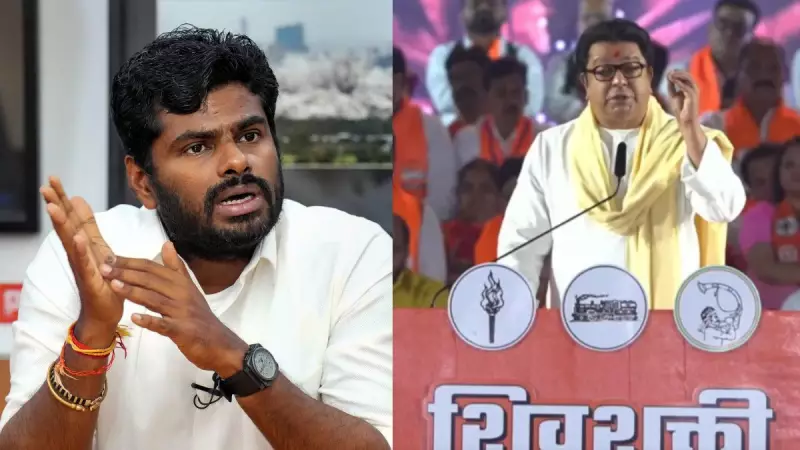
Tamil Nadu Bharatiya Janata Party (BJP) president K. Annamalai has issued a sharp and defiant response to Maharashtra Navnirman Sena (MNS) chief Raj Thackeray's recent verbal attack. Thackeray had mockingly referred to Annamalai as "Rasmalai," a popular Indian sweet, suggesting he was soft. Annamalai, however, has made it clear he is not afraid of threats and has boldly declared his intention to visit Mumbai.
The Spark: Raj Thackeray's 'Rasmalai' Remark
The political controversy ignited when Raj Thackeray, during a public address, took a dig at the Tamil Nadu BJP leader. Without naming Annamalai directly, Thackeray used the metaphor of "Rasmalai" to imply that the leader was not a serious or formidable political opponent. This comment was widely interpreted as a dismissive and belittling remark aimed at Annamalai's political stature and his party's expansion efforts in Tamil Nadu.
Thackeray's jibe is seen in the context of the BJP's attempts to strengthen its footprint in southern states, a move that often brings it into direct or indirect conflict with regional parties and sentiments. The MNS, known for its strong stance on Marathi pride and identity, has historically been critical of political interventions from outside Maharashtra.

Annamalai's Fiery Retort and Mumbai Declaration
K. Annamalai did not take the comment lightly. In a robust counter, he addressed the media, firmly stating that he is not intimidated by such remarks or any implied threats. Annamalai explicitly vowed to visit Mumbai, signaling his refusal to be cowed by regional political rhetoric.
"I am not afraid of threats," Annamalai asserted, emphasizing his right as an Indian citizen to travel anywhere in the country. His statement was a clear message of defiance, positioning himself as a national leader who operates beyond the constraints of regional political barbs. He turned the 'Rasmalai' jibe on its head, suggesting that his political work and resolve are anything but soft.
Broader Implications of the Political Clash
This war of words between the leaders of two significant regional units of national political streams highlights several ongoing tensions in Indian politics. Firstly, it underscores the challenges national parties like the BJP face when navigating the complex landscape of regional identity and pride, often championed by parties like the MNS.
Secondly, the exchange brings to the fore the style of political discourse, where personal metaphors and culinary comparisons are used as political weapons. Annamalai's response, however, shifts the focus from personality to principle—the principle of free movement and political engagement across state lines.
The incident sets the stage for a potential flashpoint should Annamalai follow through with his planned visit to Mumbai. It raises questions about political hospitality, the right to campaign nationally, and the boundaries of regional political discourse. For the BJP, Annamalai's stance projects an image of a leader standing firm against pressure, which could resonate with its support base.
Ultimately, this verbal duel between K. Annamalai and Raj Thackeray is more than just a spat; it is a microcosm of the larger tussle between expanding national political influence and entrenched regional identities. Annamalai's promise to visit Mumbai, unfazed by the 'Rasmalai' label, marks a significant moment in this continuing political narrative.