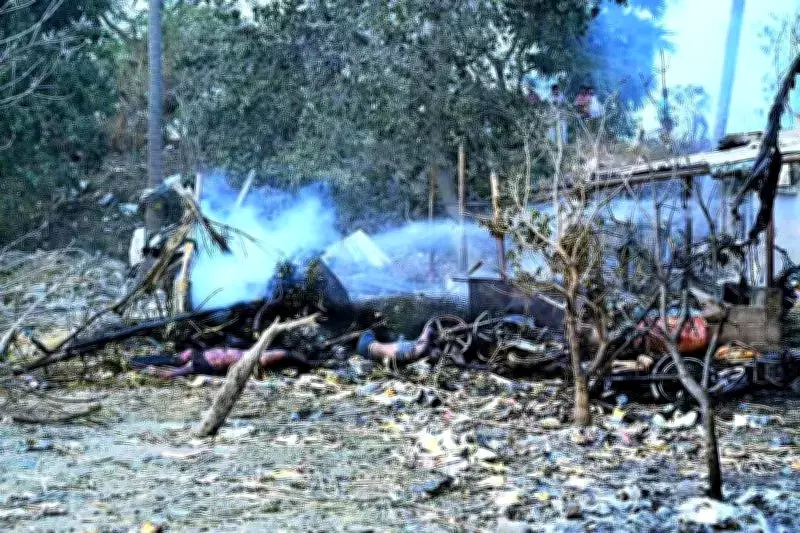
Deadly Explosion Rocks Firecracker Unit in Andhra Pradesh's Kakinada District
A catastrophic explosion at a firecracker manufacturing unit in Vetlapalem village, Kakinada district, Andhra Pradesh, on Saturday afternoon has resulted in the tragic deaths of at least 20 individuals and left 12 others with serious injuries. Officials have expressed grave concerns that the death toll may rise in the coming days, as many of the injured are in critical condition and unlikely to survive.
Details of the Tragedy and Immediate Aftermath
The blast, which occurred around 2:10 PM, was described by locals as a deafening explosion that was quickly followed by thick smoke and a massive fire. The intensity of the heat prevented many villagers working in nearby fields from reaching the accident site promptly. The explosion caused significant damage to nearby homes, shattering glass windows and damaging electronic gadgets, leaving residents, particularly the elderly and children, deeply shaken.
Rescue operations were harrowing, with teams having to navigate through strewn human body parts and a putrid smell to evacuate the injured. The odour of burnt human flesh lingered almost half a kilometer away from the unit. Body parts were recovered far from the site due to the force of the blast, and the charred remains were collected by the state disaster response force for later identification through DNA testing.

Investigation and Suspected Causes
Fire officials have not yet identified the exact cause of the explosion but suspect it may have been triggered by a small spark igniting large quantities of raw materials, including charcoal powder, sulphur, and potassium, stored in the unit's sheds. District Fire Officer Saikrishna Rajesh noted that an explosion of this magnitude would not be possible with just the permissible limit of 15 kg of chemicals, suggesting the unit may have stockpiled beyond legal limits.
The unit had reportedly obtained permission to manufacture small crackers but was also producing larger ones and may have violated storage regulations. Despite this, it had complied with other safety measures, such as maintaining a safe distance from residential areas and storing water for emergencies.
Victims and Unit Ownership
Most of the workers in the unit were women from nearby villages, though the exact number of employees at the time of the blast remains unknown due to the absence of the owner. The unit owner, Adabala Nani, is currently absconding, while his father, Adabala Srinu, was present during the explosion and is among the victims. By the time the fire was extinguished, the entire premises were reduced to ashes, with 20 bodies recovered charred beyond recognition. Nine of the injured were admitted to Kakinada Government General Hospital, all in critical condition.
Government Response and Relief Measures
The state government has ordered an inquiry into the incident. Andhra Pradesh Chief Minister N Chandrababu Naidu cut short his official visit to north coastal Andhra and camped in Kakinada to oversee relief and rescue operations. He announced an ex gratia of Rs 20 lakh each to the kin of the deceased and suspended four officers, including the RDO, district labour officer, district fire officer, and the DSP. Naidu also threatened criminal prosecution against the unit's owners and warned of property seizure.
Prime Minister Narendra Modi condoled the deaths and announced an ex gratia of Rs 2 lakh for the families of each deceased and Rs 50,000 for the injured.
Regional Context and Historical Incidents
This tragedy marks the deadliest firecracker unit blast in Andhra Pradesh in recent memory, surpassing the previous highest toll of 11 deaths recorded in 2014. The north coastal Andhra and Konaseema region is known for numerous firecracker units, both legal and illegal, with several past explosions resulting in casualties. Officials indicated that the unit was receiving large orders due to the ongoing marriage season and had employed additional workers to meet demand, potentially exacerbating safety risks.