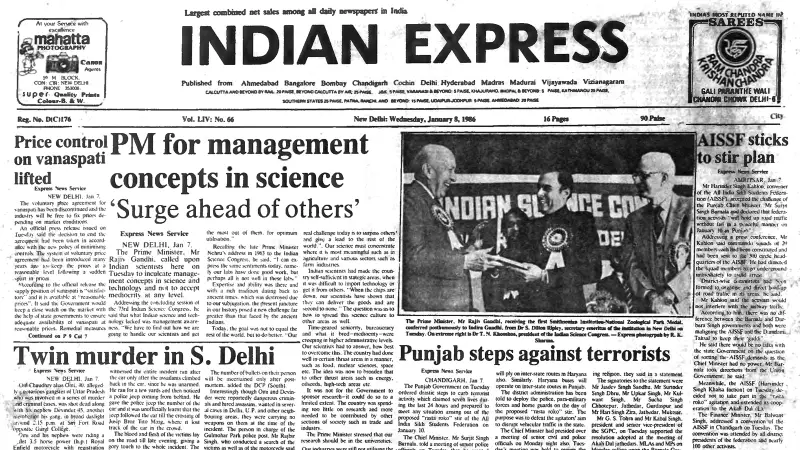
January 7, 1986, was a day of critical developments across the spheres of Indian science, internal security, and global geopolitics, as captured on the front page of The Indian Express the following day.
Rajiv Gandhi's Call to Indian Scientists
Prime Minister Rajiv Gandhi delivered a significant address at the concluding session of the 73rd Indian Science Congress in New Delhi. He called upon the nation's scientific community to integrate modern management concepts into their work in science and technology. Gandhi emphasized that the sector must not accept mediocrity at any level, identifying a lack of management awareness as a key deficiency holding back Indian science and technology.
Punjab's Drastic Measures Against Terrorism
In Punjab, the state government, led by Chief Minister Surjit Singh Barnala, ordered stringent steps to curb escalating terrorist violence. This decision came after seven lives were lost to terrorist activity in the preceding 24 hours. The administration was also preparing for potential unrest from a proposed "rasta roko" (road blockade) agitation called by the All India Sikh Students Federation (AISSF) for January 10.

Chief Minister Barnala, in a meeting with senior police officials, demanded "result-oriented" action to end the violence. However, the AISSF, through its convener Harinder Singh Kahlon, accepted the challenge and declared its activists would "hold up road traffic without fail in a peaceful manner" on the scheduled date. Kahlon revealed that commando squads of 20 members each had been formed and dispatched to the federation's 300 circle headquarters, with instructions to go underground to avoid arrest.
Libya Braces for Imminent Attack
On the international front, Libya was on high alert, anticipating a potential military strike. Most of the capital, Tripoli, was blacked out as a precaution. An aide to Libyan leader Muammar Gaddafi predicted that a U.S.-aided Israeli attack could occur "at any time."
The Libyan government actively briefed the diplomatic community on the perceived threat. Officials summoned diplomats from Eastern Bloc nations to the Foreign Ministry. In separate meetings with envoys from Western Europe, Africa, and Asia, Libyan officials reiterated their expectation of an imminent attack, highlighting the tense global atmosphere of the time.
These parallel narratives from January 7, 1986—a prime minister's vision for scientific progress, a state's struggle against internal militancy, and a nation's anxiety on the world stage—paint a vivid picture of a multifaceted historical moment.