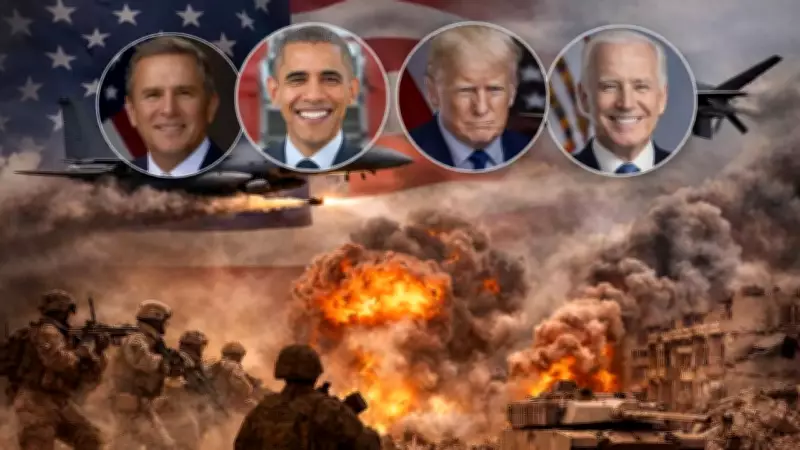
Two Decades of US Military Strikes: A Global Impact Analysis Since 2001
The September 11, 2001 attacks triggered one of the most significant transformations in American foreign policy in modern history. Over the subsequent two decades, the United States has conducted military strikes, full-scale wars, and extensive air campaigns across multiple continents, fundamentally reshaping global geopolitics under four successive presidential administrations.
The Global Reach of American Military Operations
According to comprehensive analyses referenced by international media, the United States has bombed at least ten countries since initiating what former President George W. Bush termed the "war on terror." These nations include Afghanistan, Iraq, Yemen, Pakistan, Somalia, Libya, Syria, Venezuela, Nigeria, and Iran. The operations have ranged from large-scale invasions and conventional air campaigns to targeted drone strikes and covert missile operations.
Despite repeated political pledges to reduce overseas military involvement, the pattern of engagement has persisted across different presidencies. As noted by Al Jazeera, "Since the September 11, 2001 attacks, the US has engaged in three full-scale wars and bombed at least 10 countries in operations ranging from drone strikes to invasions, often multiple times within a single year."
The Human Cost: Nearly One Million Lives Lost
Research conducted by Brown University's Costs of War project reveals staggering human consequences from these conflicts. Their analysis estimates that approximately 940,000 people have died directly in wars connected to US-led campaigns since 2001 across Afghanistan, Pakistan, Iraq, Syria, Yemen, and other conflict zones.
These figures account only for direct combat deaths from air strikes, ground operations, and war-related violence. The actual human toll is substantially higher when considering indirect deaths caused by collapsed healthcare systems, food shortages, displacement, disease outbreaks, and infrastructure destruction during prolonged conflicts. Millions of civilians were displaced during these wars, creating refugee crises that extended far beyond original battle zones.
Financial Burden: Trillions Spent on Military Campaigns
The economic impact of US military operations since 2001 has been equally monumental. According to the Costs of War project, the United States has spent an estimated $5.8 trillion funding conflicts linked to the war on terror over the past two decades.
This expenditure breaks down into several critical categories:
- $2.1 trillion spent by the US Department of Defense
- $1.1 trillion allocated to the Department of Homeland Security
- $884 billion used to increase the base defense budget
- $465 billion dedicated to veterans' medical care
- $1 trillion paid in interest on loans used to finance the wars
Analysts project that the United States will spend at least another $2.2 trillion over the next three decades on veterans' healthcare and related support. When combined with existing expenditures, the total financial burden could approach $8 trillion, representing one of the most expensive military campaigns in modern history.
Afghanistan: America's Longest Military Conflict
The initial military response to 9/11 began with Operation Enduring Freedom in Afghanistan on October 7, 2001. While US forces and allied Afghan groups quickly overthrew the Taliban government within weeks, the conflict evolved into a prolonged insurgency that became the longest military engagement in American history.
The Costs of War project estimates approximately 241,000 direct deaths during the Afghanistan conflict, including at least 3,586 soldiers from the United States and NATO allies. Financially, the war cost the United States an estimated $2.26 trillion before the final troop withdrawal in 2021, which was followed by the Taliban's rapid return to power.
Iraq War and Weapons of Mass Destruction Claims
The second major post-9/11 conflict began with the March 20, 2003 invasion of Iraq, justified by claims that Saddam Hussein possessed weapons of mass destruction. Although these claims later proved false, the invasion proceeded with coalition support, leading to the rapid capture of Baghdad and toppling of Hussein's government.
The subsequent years witnessed widespread instability, sectarian violence, and insurgency that contributed to the rise of ISIL (ISIS). The United States completed its combat force withdrawal in 2011 under President Barack Obama, though the region continued to experience significant turmoil.
The Expansion of Drone Warfare
Beyond conventional conflicts, the United States dramatically expanded its use of drone strikes and targeted air campaigns beginning in the mid-2000s. The Central Intelligence Agency initiated drone operations in Pakistan's tribal regions, targeting al-Qaeda and Taliban leaders believed to be operating along the Afghan border.
During the Obama administration, drone warfare expanded significantly, with operations extending to Somalia against al-Qaeda affiliates and al-Shabab militants, and to Yemen targeting leaders of al-Qaeda in the Arabian Peninsula. These campaigns represented a major evolution in American military strategy, extending operations beyond traditional battlefields without formal war declarations.
NATO Intervention in Libya and Regional Consequences
In 2011, the United States participated in a NATO-led intervention in Libya during the uprising against Muammar Gaddafi. Western forces launched air and missile strikes to enforce a no-fly zone and prevent government attacks on rebel-held areas, ultimately leading to Gaddafi's government collapse and his subsequent capture and death.
The aftermath created prolonged instability in Libya, with the country fragmenting into rival political factions and armed groups, triggering years of internal conflict that continues to affect regional security.
Confronting ISIL in Iraq and Syria
Another significant phase of US military engagement began in 2014 when Washington launched operations against ISIL after the militant group seized large territories across Iraq and Syria. The United States led a coalition conducting extensive air strikes while supporting local ground forces.
This period also saw intensified confrontation with Iran-backed groups, culminating in the January 2020 drone strike that killed Iranian General Qassem Soleimani, a key commander in Iran's Islamic Revolutionary Guard Corps.
Continued Military Engagement and Strategic Questions
More than two decades after the war on terror began, the United States maintains military operations and security partnerships across multiple regions. While large-scale ground wars have diminished compared to the early 2000s, air strikes, counterterrorism missions, and strategic deployments remain central to US foreign policy.
The recent escalation involving US and Israeli strikes on Iran has again highlighted the enduring role of military power in Washington's international security approach. For critics, the extensive list of conflicts since 2001 raises serious questions about the effectiveness and consequences of sustained military intervention. Supporters maintain these operations were necessary to counter terrorism and protect American strategic interests.
What remains undeniable is the monumental scale of human and financial costs: hundreds of thousands of lives lost and trillions of dollars expended, making the post-9/11 era one of the most consequential periods in modern US military history with lasting global implications.