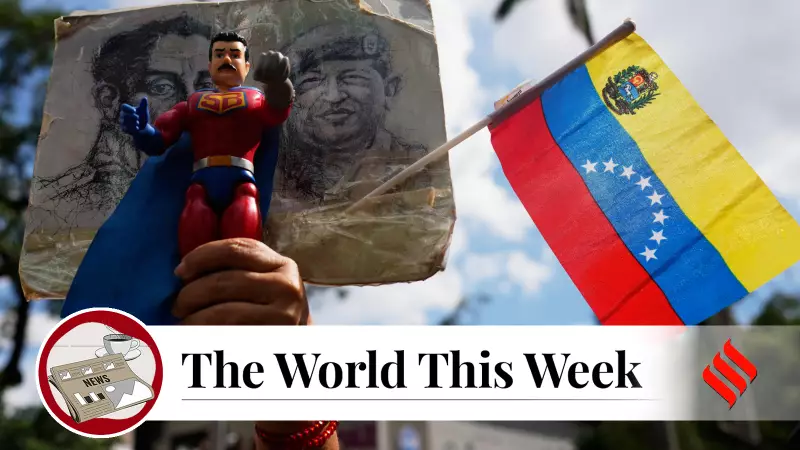
The first week of 2026 has been one of unprecedented geopolitical shocks, reshaping global alliances and raising existential questions for the international order. From a daring American military operation in South America to a crisis within the world's most powerful military alliance and a rising challenge to a decades-old theocracy in the Middle East, the world finds itself at a series of crossroads.
Operation Absolute Resolve: A Sitting President Captured
The year began with a stunning act that sent shockwaves across capitals worldwide. On January 3, 2026, under the covert Operation Absolute Resolve, United States military forces entered Venezuela and successfully captured the country's sitting president, Nicolás Maduro, along with his wife. The entire operation was concluded within three hours, effectively dismantling the Bolivarian Republic established by Hugo Chávez in 1999.
Maduro was swiftly transported to New York, where he is currently held in federal custody at the Metropolitan Detention Center in Brooklyn. His next hearing is scheduled for March 17, 2026. He is being represented by defence attorney Barry Pollack, known for defending WikiLeaks founder Julian Assange.
In Caracas, former Vice President Delcy Rodríguez was sworn in as the interim president on January 5, a move that surprised many who expected opposition figures like María Corina Machado or Edmundo González to take charge. The US has outlined a three-step strategy for Venezuela's transition, with former President Donald Trump stating Washington will run the country for a transitional period, exert control over its oil sales, and use the proceeds to rebuild infrastructure and reimburse American costs.
NATO's Existential Dilemma: The US vs. Denmark Over Greenland
Almost simultaneously, the North Atlantic Treaty Organization (NATO) was plunged into its most severe internal crisis. The Trump administration has aggressively renewed its push to acquire Greenland, an autonomous territory of Denmark, citing national security needs and refusing to rule out the use of military force.
This threat puts NATO's foundational Article 5 collective defence principle in an impossible bind, as both the US and Denmark are founding members. Danish Prime Minister Mette Frederiksen has warned that an attempted US military takeover would mean "the end of NATO" and the collapse of the post-World War II security architecture. European powers, including France, Germany, Poland, and the UK, have expressed firm solidarity with Denmark.
Iran's Protests Find a Royal Face
Meanwhile, in Iran, anti-regime protests triggered by a severe economic crisis and a crashing currency have intensified, entering their second week. Sparked in Tehran's Grand Bazaar on December 28, the demonstrations have spread to over 111 cities across all 31 provinces. The government crackdown has led to at least 42 deaths and over 2,270 detentions.
Critically, the protests have found a unifying figure in Reza Pahlavi, the exiled son of Iran's last Shah. Pahlavi, living in the US, has emerged as the de facto leader of the movement and has declared his readiness to return to Iran and lead a transitional government if the protesters succeed in forcing a regime change. This development piles pressure on the government of President Masoud Pezeshkian and the 86-year-old Supreme Leader, Ayatollah Ali Khamenei, who is reportedly facing health issues and internal concerns about succession.
Global Repercussions and the 'Who's Next?' Question
The US capture of a sitting head of state has governments worldwide, particularly those at odds with Washington, asking: "Who or where is next?" Analysts point to several nations where similar operations could be contemplated, including Mexico (for its cartel war), Colombia, Cuba, Iran, and North Korea. Pyongyang has already responded to Maduro's capture by firing ballistic missiles, calling it a "justified response."
Adding to the week's tensions, the US also intercepted and captured two sanctioned Russia-linked oil tankers, the Marinera (formerly Bella 1) and the M/T Sophia, as part of its enforcement actions against the shadow fleet transporting illicit oil.
This confluence of events marks a dramatic and volatile start to 2026, challenging international norms, testing military alliances, and potentially redrawing the political map in multiple regions. The world watches anxiously to see where the next shock will originate.