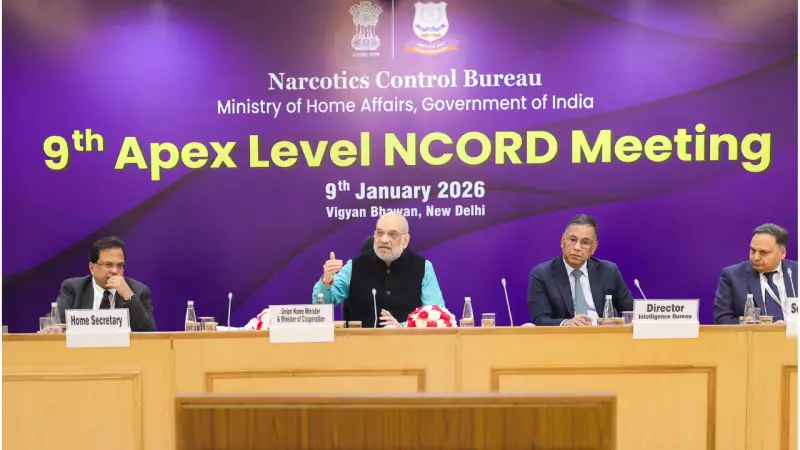
Union Home Minister Amit Shah on Friday led a high-level meeting to reinforce India's fight against the scourge of narcotics, unveiling plans for a decisive nationwide push. Chairing the ninth apex session of the Narco-Coordination Centre (NCORD) in the national capital, Shah conducted a comprehensive review of the existing strategy to counter drug trafficking and substance abuse.
Three-Year National Campaign and a 2029 Roadmap
In a significant announcement, the Home Minister declared that the government will launch an extensive nationwide campaign against drugs starting March 31, 2026. This initiative is slated to run for a period of three years and is designed to accelerate progress towards a drug-free India through multi-front action.
Shah directed all central government departments to draft a detailed roadmap extending up to the year 2029. He emphasised that these plans must include a robust monitoring mechanism to address the drug problem in a holistic manner. The minister framed the challenge not as a mere law-and-order issue but as a grave threat intrinsically linked to narco-terrorism, posing a direct danger to the nation's future generations.

A Three-Pillar Strategy: Supply, Demand, and Compassion
Outlining the government's approach, Amit Shah stated it rests on three fundamental pillars. The first involves taking stringent action to dismantle drug supply chains. The second focuses on strategic measures to reduce demand for narcotics. The third pillar advocates for a humane response to mitigate harm among existing users.
"There should be no leniency towards those involved in manufacturing and selling drugs," Shah asserted. However, he added that individuals who have begun using drugs should be dealt with sensitively. He highlighted the devastating impact of drug abuse on the health, cognitive abilities, and overall performance of youth, noting its contribution to social unrest.
Focus on Outcomes and Evolving Tactics
Shah stressed the critical need to strengthen command structures, compliance, and accountability within the anti-narcotics framework. He instructed officials to shift focus towards tangible outcomes and impact rather than the number of meetings conducted.
The Home Minister called for regular reviews of actions taken against the kingpins, financiers, and logistics networks of the drug trade. He also emphasised improving conviction rates by ensuring the effective use of Forensic Science Laboratory (FSL) reports and the timely filing of charge sheets.
Acknowledging changing patterns in drug distribution and payment methods, Shah urged authorities to continually update their strategies. He announced that state police forces would form permanent, mission-mode teams, leveraging intelligence inputs and artificial intelligence to a greater extent. Sustained public awareness campaigns were also underlined as essential for prevention.
In a related development, Amit Shah inaugurated the new office of the Narcotics Control Bureau (NCB) in Amritsar, Punjab, a region significantly affected by cross-border drug trafficking. This move is seen as bolstering the operational capabilities of the premier anti-drug agency in a key location.