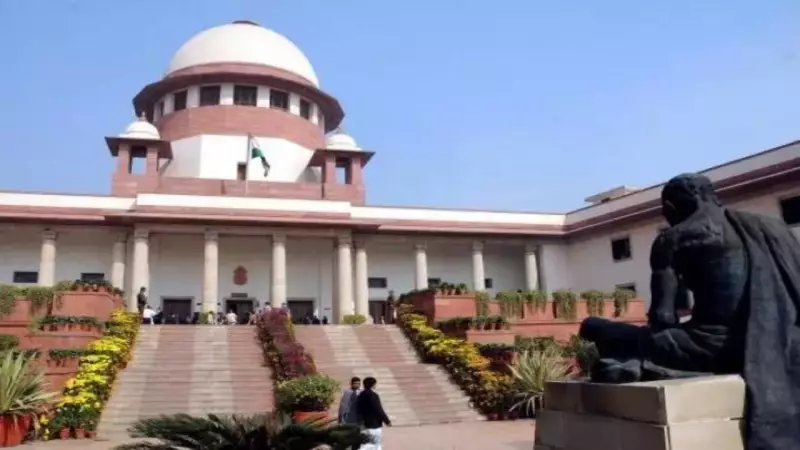
The Supreme Court of India has turned its critical gaze inward, expressing deep concern over a growing trend where benches overturn orders passed by earlier benches within days or months of their pronouncement.
Judicial Authority Under Threat
On Wednesday, a bench comprising Justices Dipankar Datta and Augustine George Masih observed "painfully" that this practice would "undermine this court's authority." The court highlighted several recent instances where this occurred, including cases related to dog bite menace, retrospective environmental clearance, Bhushan Steel Ltd's insolvency, and the ban on firecrackers.
The bench emphasized that public confidence in the judiciary would be seriously compromised if cases were routinely reopened and special benches constituted to rehear them at the request of parties dissatisfied with earlier verdicts.

Constitutional Principles at Stake
Quoting Justice Robert Jackson, the court stated: "We are not final because we are infallible, but we are infallible only because we are final." The bench elaborated on the significance of Article 141 of the Constitution, which establishes that the law declared by the Supreme Court is binding on all courts.
"The pronouncement of a verdict by a bench on a particular issue of law should settle the controversy, being final, and has to be followed by all courts as law declared by SC," the bench asserted. It warned that if verdicts were allowed to be reopened frequently, the very purpose of Article 141 would be defeated.
Recent Examples and Current Case
The court referenced the Delhi Metro Rail Corporation (DMRC) case as another instance where a 2021 verdict was overturned through a curative petition last year. In that matter, the court had quashed the Rs 7,687-crore award in favor of Delhi Airport Metro Express Private Ltd (DAMEPL).
The current observations came while hearing a plea seeking relaxation of bail conditions for an accused who was directed not to leave Kolkata during a murder trial. The court noted that the applicant had filed his application after the retirement of the apex court judge who had imposed the condition, and ultimately dismissed his plea.
The bench clarified that judicial discipline, propriety and comity demand that succeeding benches of different judges should defer to views expressed by earlier benches, unless there was something "so grossly erroneous on the face of the record or palpably wrong" that it necessitated a relook through review or curative petitions.
"As judges of this court, we are alive to the position that overturning a prior verdict by a later verdict does not necessarily mean that justice is better served," the bench concluded, choosing not to walk that path in the current case while emphasizing that any restrictive orders must be based on worthy reasons.