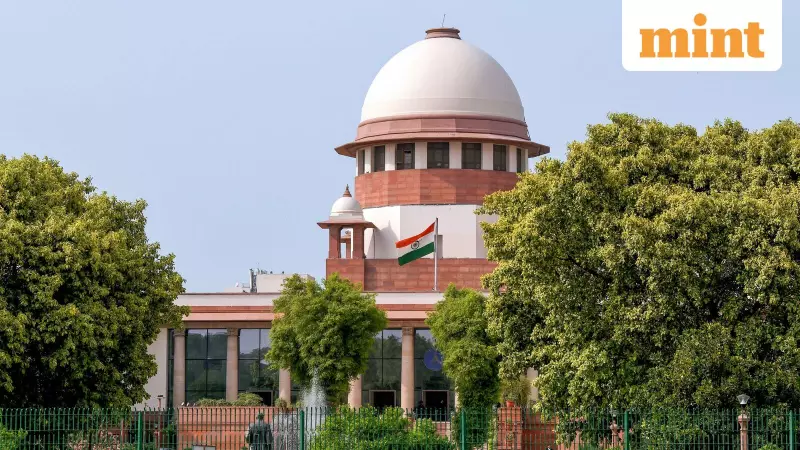
In a landmark judgment that could significantly impact state-level economic policymaking, the Supreme Court has clarified that constitutional authorities cannot be bound by fixed timelines when approving bills passed by state legislatures.
Constitutional Bench Rejects Deemed Assent Concept
A five-judge Constitution Bench led by Chief Justice B.R. Gavai delivered a crucial verdict on Thursday, stating that courts cannot impose specific timeframes on the President of India or state governors to approve bills. The bench, which included Justices Surya Kant, Vikram Nath, P.S. Narasimha, and Atul S. Chandurkar, explicitly rejected the concept of deemed assent, calling it a constitutional fiction that disturbs the country's federal balance.
The court overturned its previous judgment that had introduced fixed timelines and suggested bills could be automatically approved if constitutional authorities delayed action. According to the bench, such directions improperly take away powers that the Constitution exclusively grants to the President and governors.
Potential Impact on State Economic Reforms
This ruling raises concerns about possible delays in crucial state economic bills, particularly in domains such as business, finance, and infrastructure. Historical examples from Tamil Nadu, Punjab, and West Bengal demonstrate how prolonged assent periods have previously stalled important economic reforms.
In Tamil Nadu, the Online Gambling Prohibition Bill passed in October 2022 remained in legislative limbo for months, creating significant uncertainty for the gaming industry until final approval came in April 2023. Similarly, Punjab faced substantial delays with multiple bills from 2023, including those dealing with municipal administration and electricity reforms, which held up tariff decisions and infrastructure planning until judicial intervention.
West Bengal experienced comparable challenges, with Governor C.V. Ananda Bose finally approving several important bills including the Bengal Taxation Tribunal (Amendment) Bill, 2022, and the West Bengal Town and Country Planning (Amendment) Bill, 2023, only in April 2025 after extended delays.
Checks and Balances in the New Framework
Despite restoring full discretion to constitutional authorities, the Supreme Court established important safeguards against indefinite delays. The judgment clarifies that governors cannot keep bills pending indefinitely and must act promptly by either approving legislation, returning it, rejecting it, or sending it to the President for consideration.
Legal expert Rishabh Gandhi, founder of Rishabh Gandhi and Advocates, emphasized the practical implications: These examples show how delayed assent has become a major bottleneck for state-level economic policymaking. A bill may be passed with fanfare, but until the assent comes, it has the legal force of a press note.
Suchitra Chitale, managing partner at Chitale & Chitale Partners, interpreted the ruling as placing clear responsibility on governors: Governors no longer have the luxury of sitting on bills indefinitely. The mandate of the legislature must prevail, and the Supreme Court has now made it clear that a governor has only three constitutionally valid options.
Another legal perspective came from Parth Contractor, founder of Chambers of Parth Contractor, who expressed optimism about the system's functionality: Things have broadly moved well. These issues usually arise only when political considerations come into play. Ultimately, both sides know how to manage their positions.
Origins and Constitutional Context
The case originated from a prolonged standoff between the Tamil Nadu government and Governor R.N. Ravi, where several bills remained pending without approval, return, or referral to the President. The state government argued this inaction was effectively blocking governance.
President Droupadi Murmu subsequently sought constitutional clarity through a Presidential Reference under Article 143, which allows the President to seek the Supreme Court's opinion on questions of law or public importance. The matter was argued before the Constitution Bench over ten days, with judgment reserved on September 11.
The court emphasized that it was not striking down its earlier ruling in the Tamil Nadu-governor dispute but rather clarifying the correct constitutional position for future cases, as the President had not requested annulment of the previous judgment.