

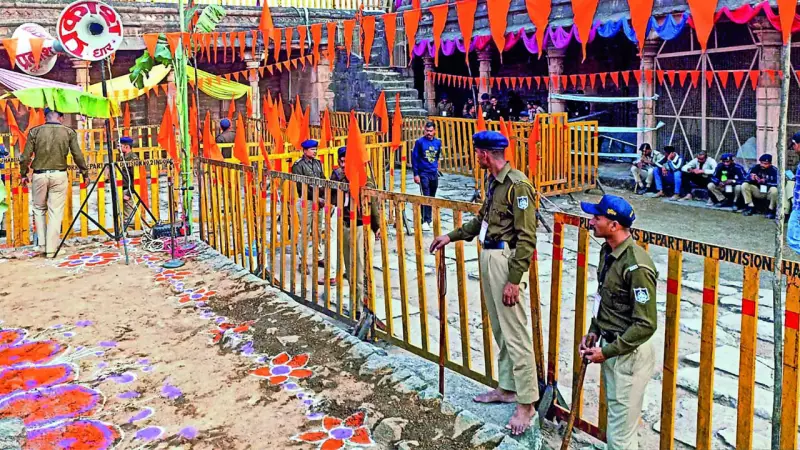
In a significant development regarding the longstanding religious dispute over the Bhojshala Saraswati Temple cum Maulana Kamal Maula Mosque in Dhar, Madhya Pradesh, the Supreme Court on Thursday fast-tracked legal proceedings while allowing both Hindu and Muslim communities to conduct their prayers simultaneously within the compound during the upcoming Basant Panchami festival.
Court Lifts Stay, Decouples from Larger Legal Challenge
The apex court, led by Chief Justice Surya Kant along with Justices Joymalya Bagchi and Vipul Pancholi, lifted the stay it had previously imposed on the case pending before the Madhya Pradesh High Court. This move effectively revives the legal battle over the religious character of the 11th-century monument, which has been a persistent source of contention between Hindu and Muslim communities for decades.
Importantly, the Supreme Court also decoupled this specific dispute from the broader constitutional challenge to the Places of Worship Act, 1991. This separation allows the Bhojshala case to proceed independently without being entangled in the larger legal framework debate.

Simultaneous Prayers in Demarcated Areas
With Basant Panchami coinciding with a Friday this year, the court approved a unique arrangement where both communities can perform their religious rituals simultaneously within the same compound but in separate, clearly demarcated areas.
The Hindu community will be permitted to conduct Saraswati Puja throughout the entire day, as their tradition requires day-long observances. Meanwhile, the Muslim community will be allowed to offer Juma Namaz between 1:00 PM and 3:00 PM, the prescribed time for Friday prayers.
The court emphasized that separate ingress and egress points would be established within the compound to ensure smooth movement and prevent any potential conflicts between the two groups.
Administrative Arrangements and Security Measures
Additional Solicitor General K M Nataraj, representing the state government, assured the court that all necessary arrangements would be implemented to maintain law and order during the simultaneous prayers. The district administration has been authorized to issue visitor passes or adopt any other reasonable means to prevent untoward incidents.
The bench specifically requested senior advocate Salman Khurshid, appearing for the Muslim side, to provide the state government with an estimate of the number of people expected to offer Friday prayers. This information will help authorities make appropriate logistical arrangements.
Appeal for Mutual Respect and Tolerance
In its order, the Supreme Court made a heartfelt appeal to both communities to demonstrate tolerance, mutual respect, and cooperation with local authorities. "We appeal to both sides to observe mutual respect and trust towards each other," the bench stated, recognizing the sensitive nature of the religious observances.
The court's decision came after hearing arguments from both sides. Advocates Vishnu Jain and Ashwini Upadhyay, representing the Hindu petitioners, emphasized that the Archaeological Survey of India (ASI) had already submitted its report in a sealed envelope, but proceedings had been stalled due to the Supreme Court's stay order.
Expedited Hearing in High Court
The Supreme Court directed the Madhya Pradesh High Court to expedite the hearing of the case, preferably before a division bench headed by the Chief Justice or the senior-most judge. The bench specifically ordered that the sealed ASI report be opened in open court and copies provided to both parties.
Until the High Court reaches a final decision on the writ petition, all parties have been instructed to maintain the status quo at the site. This interim arrangement allows for religious observances while preserving the legal position until the dispute is resolved.
The Bhojshala complex represents one of India's most sensitive religious heritage sites, with Hindus believing it to be a temple dedicated to Goddess Vagdevi (an incarnation of Saraswati) and Muslims considering it the Kamal Maula Mosque. Thursday's Supreme Court order attempts to balance religious freedoms with legal processes while maintaining communal harmony during important religious observances.






