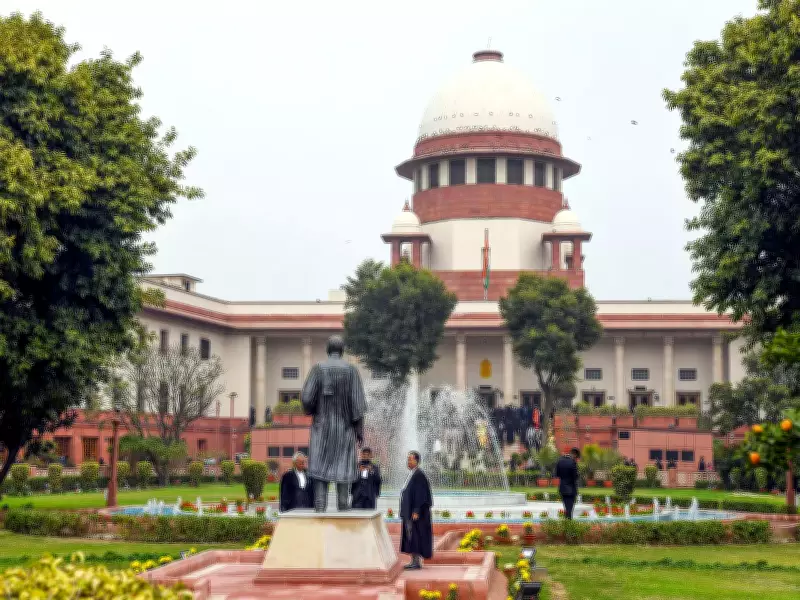
Supreme Court Overturns Conviction in 2018 Child Murder Case, Criticizes Investigation
In a significant ruling, the Supreme Court of India has acquitted a man accused of murdering his six-year-old stepdaughter in 2018, citing a botched investigation and weak evidence that failed to establish guilt beyond reasonable doubt. The case, which originated from Chhattisgarh, has drawn attention to legal technicalities surrounding evidence admissibility in criminal proceedings.
Case Background: Missing Girl and Charred Remains
The tragic incident dates back to 2018 when a six-year-old girl went missing. According to reports, she was last seen with her stepfather, Rohit Jangde. Eight days after her disappearance, Jangde was arrested, and he subsequently led police to a location where the charred remains of the child were discovered. This discovery formed a crucial part of the prosecution's case against him.
Supreme Court's Ruling: Evidence Deemed Insufficient
A bench comprising Justices Sanjay Kumar and K Vinod Chandran delivered the verdict, acquitting Jangde of the murder charge. The court emphasized that the investigation was flawed and left many questions unanswered, ultimately relying on mere conjecture rather than solid evidence. In their judgment, the justices stated, "In the present case, the murder of a six-year-old girl went unpunished and her stepfather was incarcerated on mere conjecture."
The bench pointed out several gaps in the case:
- No other evidence linked Jangde to the murder except that he was the last person seen with the child, as per a neighbor's account.
- There was a long gap without any complaint about the missing child, and no one questioned the accused despite family and police being informed she went with him.
- Since the corpus delicti (the body) was not fully recovered, the time of death could not be specified, further weakening the prosecution's timeline.
Legal Technicalities: Admissibility of Statements
A key aspect of the ruling involved the interpretation of legal provisions regarding statements made by an accused that lead to the discovery of facts. The Supreme Court relied on decades-old judgments to assess the admissibility of Jangde's statement to police.
- Over 65 years ago, the Supreme Court ruled that such statements are admissible only when made in police custody.
- The bench also referenced a nearly 100-year-old ruling by the Calcutta High Court, where the then Chief Justice expressed anguish over this legal limitation, calling it absurd but leaving it to the legislature to amend.
Justice Chandran elaborated that even if Jangde's knowledge leading to the discovery of bone remnants was considered, it would be a weak piece of evidence under Section 8 of the Evidence Act, which can only offer corroboration and not result in conviction alone. He stated, "The evidence under Section 8 can only offer corroboration and cannot by itself result in a conviction."
Conclusion: Benefit of Doubt Granted
Ultimately, the Supreme Court concluded that the scales tilted in favor of the accused due to the investigative lapses and lack of concrete evidence. The bench declared, "We are hence unable to uphold the conviction of the accused, and he has to be necessarily given the benefit of doubt." This ruling underscores the importance of thorough investigations and adherence to legal standards in criminal cases, ensuring that convictions are based on robust proof rather than assumptions.