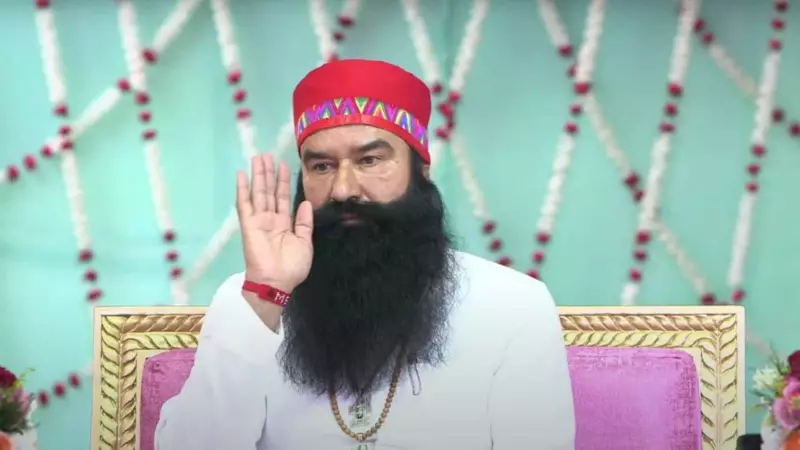
US Witness in Ram Rahim Castration Case Seeks Time for Eye Treatment
A special Central Bureau of Investigation court in Panchkula has granted a one-month extension to the prime witness in the castration case against Dera Sacha Sauda chief Gurmeet Ram Rahim Singh. The court gave this time for the witness to confirm his fitness for testimony through his counsel.
Witness Cites Retinal Condition for Deferment
The complainant, who lives in the United States, requested a postponement of his cross-examination last month. He stated that he is undergoing treatment for retinal vein occlusion. His doctors have advised him to avoid looking at camera lenses for extended periods.
This medical condition makes it difficult for him to participate in cross-examination via video conferencing. The court had originally fixed January 8 and 9 for recording his evidence.

Court's Order and Next Steps
In an order dated January 7, made public on Tuesday, the court noted that the next date for recording evidence will be fixed in the last week of February. The court said, "One month time is given to the witness to convey his fitness to this court through his counsel."
The court added that dates would be fixed only after consultation with officials of the Consulate General of India in New York. The witness must be found in fit condition for testimony recording to proceed.
Background of the Case
The CBI registered this castration case in New Delhi on January 7, 2015. The agency charged Ram Rahim, Dr. Pankaj Garg, and Dr. M P Singh. According to prosecution claims, Ram Rahim allegedly collaborated with these doctors to orchestrate the castration of approximately 400 followers.
The prosecution states that they claimed this procedure would bring followers "closer to God." In August 2025, a special judicial magistrate allowed the complainant's application for cross-examination through video conferencing from the US, citing security concerns.
Video Conferencing Arrangements
The CBI corresponded with the Ministry of External Affairs and the Indian Embassy to facilitate evidence recording via video conferencing. They received a positive response from the office of the Consulate General of India in New York.
Accordingly, the court fixed two dates for the witness's cross-examination on January 8 and 9 in its December 19 order. These dates have now been postponed due to the witness's medical condition.
Court Denies Request for Counsel in VC Room
In his application for postponement, the witness also requested to have his counsel present during evidence recording in the video conferencing room. He stated that Ram Rahim is an influential individual with political connections, and having counsel would help instill confidence.
The CBI did not object to this request. However, counsel for the accused opposed it, submitting that no provision exists for a lawyer to be present at a remote location during video conferencing evidence recording.
Judicial Magistrate First Class Anil Kumar Yadav heard these contentions. The court held that counsel presence at the remote point is not permitted because the public prosecutor and the witness's counsel are physically present in court.
The court said, "The presence of counsel at remote point is not permitted because when the witness is present at the remote point before the screen and public prosecutor for the CBI and his own counsel are physically present in the court, there is no need for physical presence of his counsel in VC room at the remote point."
However, the court allowed the witness's counsel to consult with him outside the remote point before evidence recording begins. The court also permitted one advocate representing the witness to accompany him to the Indian Embassy or Consulate General office in New York on the day of evidence recording.
The court clarified that this advocate's entry into the video conferencing room is not allowed under relevant rules framed by the Punjab and Haryana High Court.