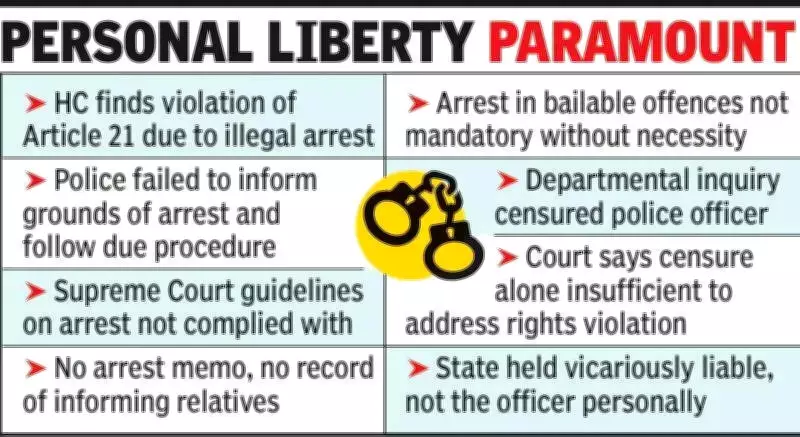
The Nagpur bench of the Bombay High Court on Monday delivered a significant ruling, stating that a police officer violated constitutional safeguards by arresting a 70-year-old businessman without adhering to mandatory legal procedures. The court directed the State to pay Rs 25,000 as compensation for the infringement on his personal liberty.
Court's Observations on Arrest Procedures
A division bench comprising Justices Urmila Joshi Phalke and Nivedita Mehta found that the arrest, carried out in a case registered at the Ambazari police station, failed to comply with established Supreme Court guidelines and statutory safeguards under the Code of Criminal Procedure. The court held that the action amounted to a breach of Article 21 of the Constitution, which guarantees the right to life and personal liberty.
Details of the Case
The petitioner, a resident of Gandhi Nagar, challenged his arrest through counsel PS Tiwari. The case was filed by his daughter-in-law, alleging outraging her modesty and other offences. The petitioner contended that despite responding to a notice issued by the police, he was arrested without adherence to due process of law.

Examining the record, the court noted that although a notice was issued to the petitioner, "it nowhere mentions the ground for arrest". It further observed that there was no arrest memorandum or proper documentation as mandated, nor any evidence that relatives were informed, which violated procedural safeguards laid down in key Supreme Court rulings.
Supreme Court Precedents Cited
Citing apex court precedents, the bench underscored that arrest in cognizable offences punishable up to seven years is not automatic and must strictly meet criteria. "The police officer is duty-bound to record the reasons for arrest in writing," the court reiterated, adding that any non-compliance directly impacts the legality of detention. The bench also stressed that constitutional courts are empowered to award compensation where fundamental rights are violated.
Compensation and Accountability
Referring to established jurisprudence, it observed that monetary compensation serves as a remedy for unlawful deprivation of liberty and helps enforce accountability. While noting that a departmental inquiry already found misconduct and censured the police officer, the court held that this alone could not address the violation suffered by the petitioner. It directed the government to pay compensation within eight weeks, observing that such liability falls on the State for actions of its officials.
The bench made strong observations on the role of law enforcement, stating that "when the police is a violator of law, the punishment for such violation has to be proportionately stringent so as to have an effective deterrent." This ruling underscores the judiciary's commitment to protecting fundamental rights and ensuring that law enforcement agencies adhere to legal procedures.