The Nagpur bench of the Bombay High Court has delivered a significant judgment, ruling that the term 'Koshti' appearing in certain historical records refers to a weaving vocation rather than a distinct caste identity. This decision came while restoring the 'Halba' Scheduled Tribe (ST) status of two teachers from Nagpur.
Court's Decision and Reasoning
A division bench comprising Justices Mukulika Jawalkar and Nandesh Deshpande quashed the orders of the Scheduled Tribe Certificate Scrutiny Committee dated September 29, 2020, which had invalidated the tribe claims of Mahendra Hedau and Varsha Dhanorkar. The court emphasized that there was no caste called 'Koshti' recognized until 1995 as a special backward class, and entries of 'Koshti' in documents should be treated as indicating a profession.
The judges directed the scrutiny committee to issue 'Halba' ST validity certificates to both petitioners within four weeks. This ruling holds importance amid ongoing disputes in the Vidarbha region over 'Halba-Koshti' classifications, particularly in cases where later records contradict pre-Independence documents.

Evidence Considered by the Court
The scrutiny committee had rejected the petitioners' claims after vigilance inquiries revealed school records mentioning some relatives as 'Koshti'. The committee also questioned the petitioners' socio-cultural affinity with the Halba tribe. However, the high court found that the oldest available records overwhelmingly supported the petitioners' tribal identity as 'Halba' or 'Halbi'. These records included school documents from 1904 and 1909, as well as a registered genealogical gift deed from 1914.
The bench observed that historical evidence showed several members of the Halba tribe adopted weaving as a profession, leading to 'Koshti' references in records. The petitioners' case was argued by senior counsel Anil Mardikar, assisted by SD Borkute.
Key Document: 1914 Gift Deed
One of the key documents examined by the court was a 1914 registered gift deed maintained by a traditional genealogist or 'Bhat', preserving family lineage records on palm-leaf manuscripts. The document referred to 'Halbi @ Koshti', a detail that supported the petitioners' argument that 'Koshti' denoted occupation rather than caste identity in certain historical contexts. The archaeological department also verified its authenticity. The bench observed that the gift deed was more than 100 years old and its genuineness could not be doubted.
Criticism of Scrutiny Committee
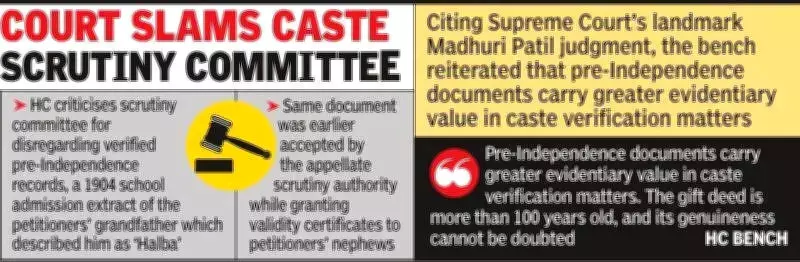
The court sharply criticized the scrutiny committee for disregarding verified pre-Independence records, particularly a 1904 school admission extract of the petitioners' grandfather, Gopal Ganpati, which described him as 'Halba'. Notably, the same document was earlier accepted by the appellate scrutiny authority while granting validity certificates to the petitioners' nephews.
The court noted that despite this position, the scrutiny committee observed a difference in ink and handwriting, terming the findings patently erroneous and perverse. Citing the Supreme Court's landmark Madhuri Patil judgment, the bench reiterated that pre-Independence documents carry greater evidentiary value in caste verification matters and warned against excessive dependence on affinity tests alone.