Nagpur High Court Cracks Down on Deadly Nylon Manja with Heavy Fines
The Nagpur bench of the Bombay High Court has taken a firm stand against the dangerous nylon kite strings known as manja. On Monday, the court announced substantial financial penalties to deter their sale and use. This decisive action aims to prevent further accidents that have claimed lives and caused serious injuries to people, birds, and animals across the region.
Strict Penalties for Violators
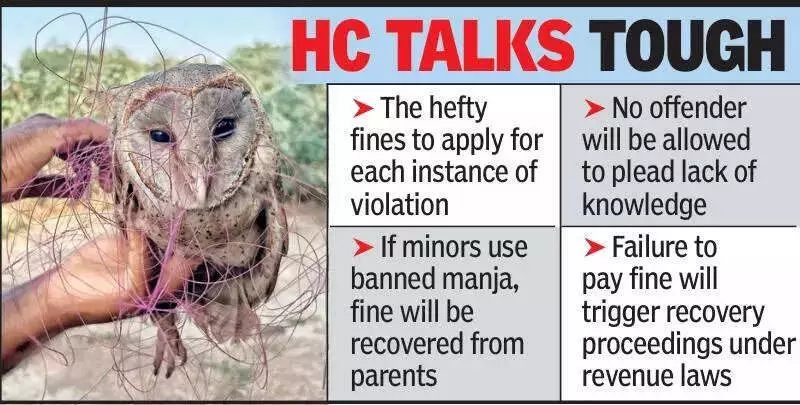
A division bench comprising Justices Anil Kilor and Raj Wakode declared the new fines. Sellers caught dealing in the banned nylon manja will face a hefty penalty of ₹2.5 lakh. Users found flying kites with this hazardous string will be fined ₹25,000. The court emphasized that these penalties apply for every single instance of violation, with no exceptions for leniency.
The bench made it clear that repeat offenses will attract repeated punishments. In cases involving minors, the financial penalty will be recovered from their parents or guardians. This measure ensures accountability extends to those responsible for supervising children.

Fund for Victim Assistance
All fines collected under this order throughout the Vidarbha region will be deposited into a dedicated public welfare fund. The court has established a special bank account for this purpose. It will be jointly operated by the Nagpur District Collector, the Municipal Commissioner, and the High Court Registrar (Administration).
The money in this fund has a specific and critical purpose. It will be used exclusively to provide medical treatment and financial assistance to victims injured in accidents caused by nylon manja. A committee will oversee the fund and determine the appropriate amount of aid for each case.
Enforcement and Reporting Mechanisms
To ensure strict enforcement, the court has directed authorities to issue formal notices to offenders. These notices will grant a period of up to 15 days to deposit the fine if immediate payment is not possible. Failure to comply within this timeframe will trigger recovery proceedings under existing revenue laws. The district administration will carry out these proceedings.
Recognizing that citizens often find it difficult to report illegal activities, the court has instructed a streamlined complaint system. The Cyber Cell of the police in every district is now tasked with creating a dedicated WhatsApp group. This group will serve as a direct channel for the public to report the sale or use of nylon manja.
Police Commissioners and Superintendents have been asked to establish a clear mechanism for swift action based on these complaints. The court also issued a warning about police accountability. If any serious incident linked to nylon manja occurs, the officer in charge of the concerned jurisdiction could face a show-cause notice for failing to enforce the court's orders.
Public Awareness Campaign
The court wants to eliminate any possible claim of ignorance regarding the new rules. To achieve this, it has directed the Police Commissioners and Superintendents to publish detailed public notices in newspapers on January 13th and 14th. These notices will widely publicize the penalties for using or selling nylon manja.
"No offender will be allowed to plead lack of knowledge of this decision," the court stated firmly. Echoing this stance, Commissioner of Police Ravinder Singal and Superintendent Harsh Poddar confirmed that claims of being unaware of the fines will not be accepted as an excuse.
The High Court issued these comprehensive directives while hearing a suo motu Public Interest Litigation (PIL). The court took up this case in view of the increasing number of injuries and fatalities linked to the use of nylon kite strings in the region.