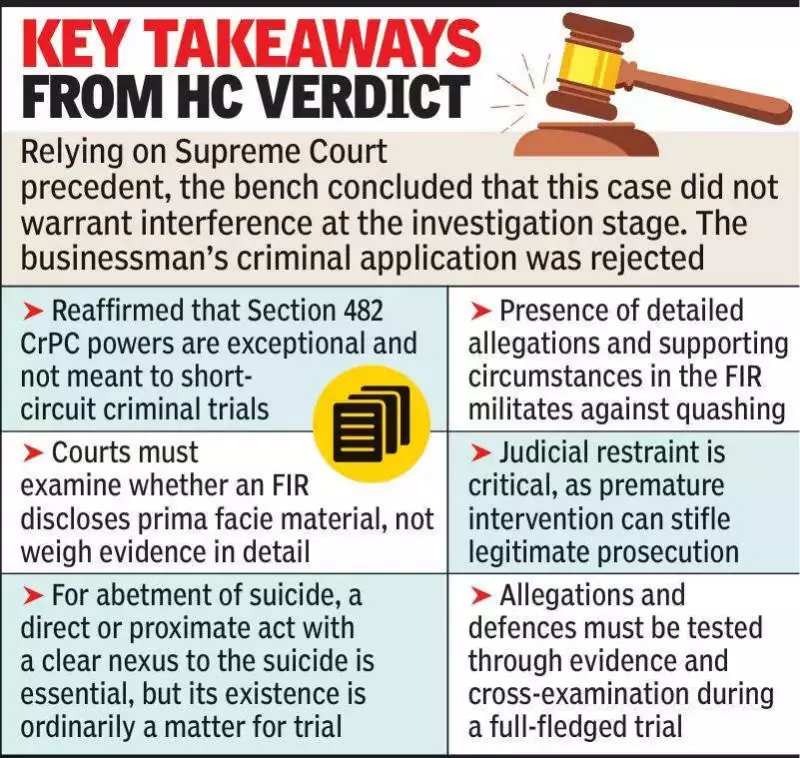
In a significant ruling, the Nagpur bench of the Bombay High Court has firmly reiterated the boundaries of judicial intervention at the initial stages of a criminal case. The court dismissed a petition filed by a businessman seeking to quash a First Information Report (FIR) against him for alleged abetment of suicide, emphasizing that inherent powers under the law cannot be used to obstruct a legitimate prosecution.
Court Upholds Prima Facie Case, Dismisses Petition
A division bench comprising Justices Urmila Joshi Phalke and Nandesh Deshpande rejected the criminal application on April 6, 2025. The applicant, a businessman from Buldhana, had sought the quashing of an FIR registered at the Ramtek police station in Nagpur (rural). The case was filed under Section 108 of the Bharatiya Nyaya Sanhita, 2023, which deals with abetment of suicide.
The tragic incident stems from the death of a man who died by suicide on April 2, 2025. His wife, the complainant, alleged that the petitioner had drawn her husband into a partnership venture. This venture involved supplying shed-nets—a UV-stabilised, knitted polyethylene fabric used in agriculture—to farmers under a government scheme.

The complaint detailed that the businessman persuaded the deceased to obtain bank loans for the venture but later failed to supply the promised material or repay the dues. Consequently, farmers and bank officials began pressuring the deceased for repayment and supplies. The wife alleged that this relentless pressure and harassment drove her husband to take his own life.
Legal Principles on Abetment and Judicial Restraint
Opposing the petition, Additional Government Pleader Neeraj Jawade argued for the prosecution. The bench meticulously examined the legal framework governing abetment. The court observed, "For attracting offence under Section 108 of BNS, what is required is a direct or proximate act which leads the deceased to commit suicide." It added that such an act must have a clear nexus with the suicide.
Upon scrutinizing the FIR, the judges concluded that it "spells out detailed methodology of the petitioner to drive persons like the husband of the complainant to commit suicide." The bench held that prima facie material existed against the businessman, warranting a full trial. It also noted the prosecution's submission that similar FIRs for identical offences were registered against the petitioner, further underscoring the necessity of a thorough trial.
Section 482 CrPC Powers Must Be Used Sparingly
The court strongly emphasized the principle of judicial restraint. It ruled that the extraordinary powers under Section 482 of the Criminal Procedure Code (CrPC) must be exercised "sparingly and with great circumspection." These powers, the bench stated, cannot be invoked to "stifle legitimate prosecution."
The judges clarified that allegations and counter-allegations must be tested "on the anvil of cross-examination" during the trial, not at the preliminary stage. Relying on Supreme Court precedents, including the State of Madhya Pradesh versus Laxmi Narayan case, the bench concluded that this matter did not warrant interference at the investigation stage.
With the dismissal of the businessman's criminal application, the police investigation is now cleared to proceed unhindered. This ruling serves as a crucial reminder of the high threshold for quashing FIRs and reinforces the judiciary's role in ensuring that genuine cases reach trial.