Mumbai Train Assault: GRP Arrests Labourer After Stone Attack Blinds Bystander
In a shocking incident of public violence, the Govt Railway Police (GRP) in Mumbai has arrested a labourer for a brutal stone-throwing attack on a local train that left a bystander permanently blind in one eye. The arrest on Thursday came after an intensive manhunt following the February 3 assault at Bandra station, which has highlighted severe safety concerns on the city's bustling railway network.
Victim's Life Altered Forever by Random Act of Violence
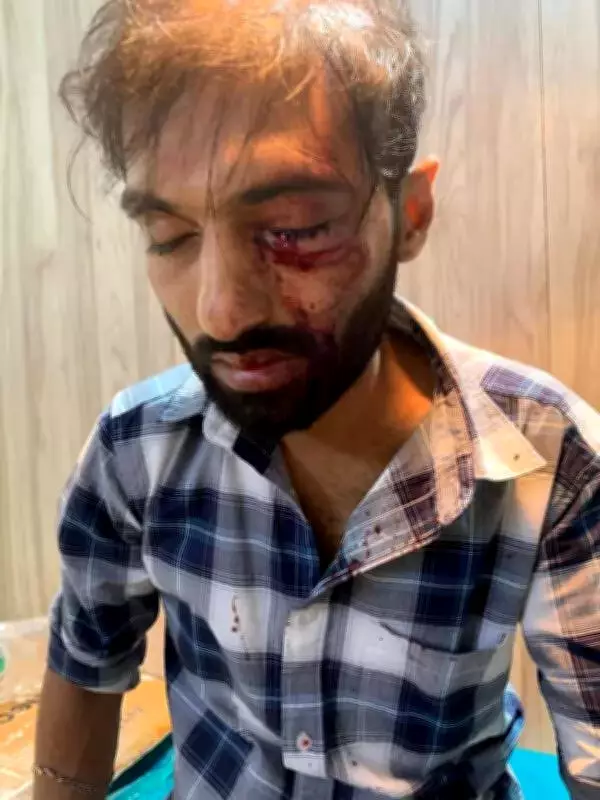
Nishant Khatri, a 28-year-old assistant manager in accounts and finance with an MBA degree, had just celebrated his engagement two days before the life-altering incident. Returning home from work at his Sakinaka office, Khatri boarded a Churchgate-bound local train from Andheri station, completely unaware of the tragedy that awaited him.
The compartment witnessed two commuters engaged in a heated argument over seating arrangements. As the train reached Bandra station, one of the disputing passengers, later identified as Yogendra Bauddha, jumped onto the tracks, picked up a stone, and initiated a dangerous assault.
"I was seated on the third seat when the first stone came from behind me and hit the train," recounted Khatri. "There was a loud impact sound that made everyone gasp in horror, but nobody was injured initially."
Chaos and Cruelty in Compartment
As pandemonium erupted in the crowded compartment, Khatri turned to his left to assess the situation. At that precise moment, a second stone—approximately the size of an adult's palm—struck him directly in the left eye, immediately causing severe bleeding and damage.
"Co-travellers watched me get injured, but nobody came forward to help," Khatri revealed with evident distress. "They didn't even pull the emergency alarm chain. I somehow managed to disembark after the train had started moving again."
After finding a home guard on the platform who assisted him, Khatri was taken to the station manager's office. He alleges being made to wait for 45 minutes for procedural formalities, though Western Railway officials have contested this claim, stating he was transported to Bhabha Hospital within 15 minutes of notification at 11:25 PM.
Medical Neglect and Surgical Intervention
The medical response proved inadequate initially. At Bhabha Hospital, doctors were unavailable, leaving a ward boy to clean Khatri's wound and administer a tetanus injection. His relatives subsequently transferred him to Hinduja Hospital, where he underwent emergency surgery.
"My eyeball was severely damaged in the incident," Khatri explained. "Doctors confirmed I will never recover vision in my left eye. For absolutely no fault of mine, my entire life has been wrecked."
Family members emphasized that Khatri serves as the sole breadwinner for his household, and the permanent loss of vision in one eye will significantly impact his professional capabilities and earning potential.
Police Investigation and Arrest
Bandra GRP registered a First Information Report immediately and assembled a dedicated investigation team under the leadership of DCP Sunita Salunke, ACP Kishore Shinde, and senior inspector Shahaji Nikam. The team meticulously reviewed CCTV footage from multiple Western Railway stations before receiving a crucial tip-off about the suspect's planned arrival at Dadar station.
A carefully coordinated trap led to the apprehension of Yogendra Bauddha, a labourer originally from Uttar Pradesh who had relocated to Mumbai eight months prior. Bauddha resides in Vasai and works at a plastics manufacturing company. Police investigations revealed he frequently travels on local trains between Vasai and Churchgate for recreational purposes.
Broader Implications for Railway Safety
This disturbing incident has raised serious questions about passenger safety protocols, emergency response mechanisms, and medical facilities at railway stations. The complete lack of immediate assistance from fellow passengers during the attack highlights concerning social attitudes toward public safety interventions.
Railway authorities now face mounting pressure to enhance surveillance, improve emergency medical services at stations, and implement stricter measures against violent behavior on trains. The case serves as a tragic reminder of how quickly routine commutes can transform into life-altering tragedies due to impulsive acts of violence.