13 Years on Four Wheels: A Lawyer's Mobile Office in Madhubani
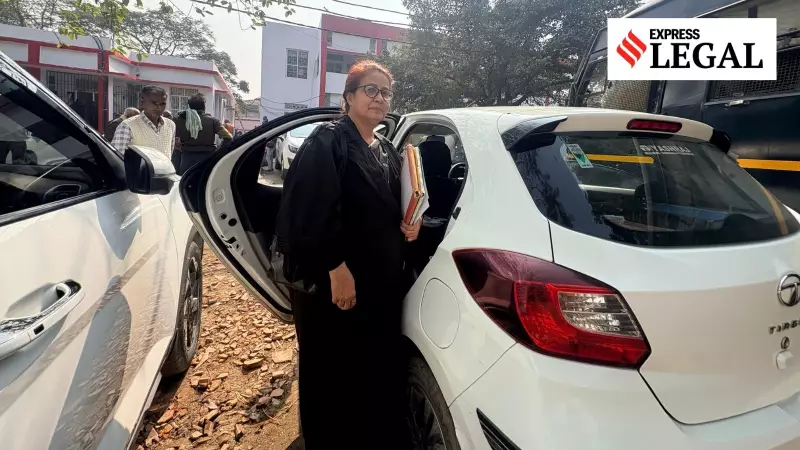
Every working day, a white Tata Tiago hatchback pulls into the Madhubani District Court parking lot. Inside, seated in the backseat, is Anita Jha. For thirteen years, this car has served as her law chamber. Clients gather around the vehicle, seeking legal advice in this unconventional setting.
No Chamber, Only a Car Backseat
Anita Jha, now 57, began practicing law twenty-eight years ago. She hails from Madhubani, Bihar. Her journey took an unexpected turn in 2013. The district court constructed a common space designated for women lawyers. However, the sign was quickly removed. Male senior lawyers claimed the chamber instead.
"Despite the vast courthouse, no chamber was allotted to me or other female lawyers in my 28 years of practice," Anita states with evident pain. She recalls March 1, 2013, clearly. On that day, she requested the promised women's chamber. Her male colleagues humiliated her in response.

Her first request for a workspace dates back to 2011. She argued that female counsel needed a chamber as they worked continuously from 10 am to 4 pm. A year earlier, she had collected around Rs 15 lakh for this purpose. The money never translated into a physical space for women.
A Symbol of Defiance and Resistance
Facing constant bullying, Anita made a bold decision. She transformed her car into her office. This act became her pratirodh, or resistance. "My decision to practice from my car was a protest against the bullying," she explains. The car symbolizes her defiance in a male-dominated compound.
Her daily routine is rigorous. She leaves her home in Kakraul village around 10 am. The 12-kilometer journey to the court takes about forty minutes. From 10:30 am until approximately 5 pm, her car becomes a sanctuary. Here, she prepares pleadings, advises clients, and develops legal strategies.
"I have no home; everything I own is in this car—my work, my identity, everything," Anita declares. She views this mobile office as a protest against systemic gender discrimination within the judiciary.
Overcoming Harassment and Humiliation
The struggle for space was intense. Anita faced direct abuse. "People hurled abuses, removed my table and chair, but I stayed," she recounts. When she attempted to set up a small office with just a table and chair, they were taken away within days. Colleagues mocked her demands, suggesting she had a broken mind.
The environment turned poisonous. Whispers in hallways escalated into overt verbal abuse. All this occurred in full daylight at the heart of the justice system. During the Maha Kumbh Mela in 2013, standing in the Ganges, she contemplated leaving Madhubani. However, a deeper realization struck her. Fleeing was not the solution. Her identity was rooted in her birthplace.
Basic Facilities Remain a Challenge
Beyond the chamber issue, basic amenities are scarce. The dearth of clean toilets poses a significant problem. Anita avoids drinking water throughout her busy workday. "I do not drink water to avoid going to the toilet. There is no clean toilet except a dirty public one," she says. This highlights the inadequate facilities for women at the court.
The Evolution of Her Mobile Chamber
Anita's journey mirrors the colors of her cars. It began with innocence, moved to defiance, and now finds a form of peace. In 2013, she started using her mother-in-law's pink Zen. Later, she used her mother's red car. In 2022, she purchased the white hatchback with her own money. Each vehicle marked a phase in her resilient career.
Personal Life and Legal Inspiration
Anita was born in 1968 in Bihar. Her father worked in the courts, while her mother was a homemaker. Frequent relocations due to her father's job took her across Bihar and Jharkhand. Despite these moves, her love for learning remained constant. She married young in 1986 and had a son shortly after.
She pursued education relentlessly, earning a BA and MA in ancient history. Initially inspired by her professor husband to teach, her father convinced her to study law. In 1989, she enrolled for an LLB at Chandradhari Mithila Mahavidyalaya in Darbhanga. She was the only woman in her batch during evening classes.

"I was fortunate that my family always supported me," she acknowledges. This support was crucial in an era when women in law were rare.
Tragedy and Changing Attitudes
In 2013, her husband of 27 years passed away. This tragic loss altered her perspective. "My legitimate demands were labelled as being too demanding," she notes. She felt her protection was snatched away. As a widow, she began viewing cases with greater compassion, deepening her commitment to justice.
Shaping Cases and Legal Legacy
Anita specializes in cases under the POCSO Act, marriage disputes, and dowry abuse. She recalls early days advocating for women's rights under Section 498A and the Domestic Violence Act. One case involving a 60-year-old widow who was gang-raped by neighbors profoundly impacted her. "The day changed me," she admits.
Another memorable case involved representing an elderly man who killed his son. It made her ponder familial dynamics deeply. Over her career, she has resolved nearly 20,000 cases. "I have seen society through the law. Criminals need help, not just punishment," she reflects.
Respect from Peers
Younger lawyers at the district court recognize her dedication. Atul Kumar Jha, a practicing attorney, states, "Anita madam is one of the best criminal lawyers." He acknowledges the misogynistic environment and lack of basic facilities for women. Another advocate, Saddam Arif, observes clients swarming her car daily. Her presence in the parking lot is a constant reminder of her resilience.
Anita Jha's story is not just about a car. It is about perseverance against gender bias. For thirteen years, her mobile office has challenged norms. It stands as a testament to her unwavering commitment to justice and equality in Madhubani's legal landscape.