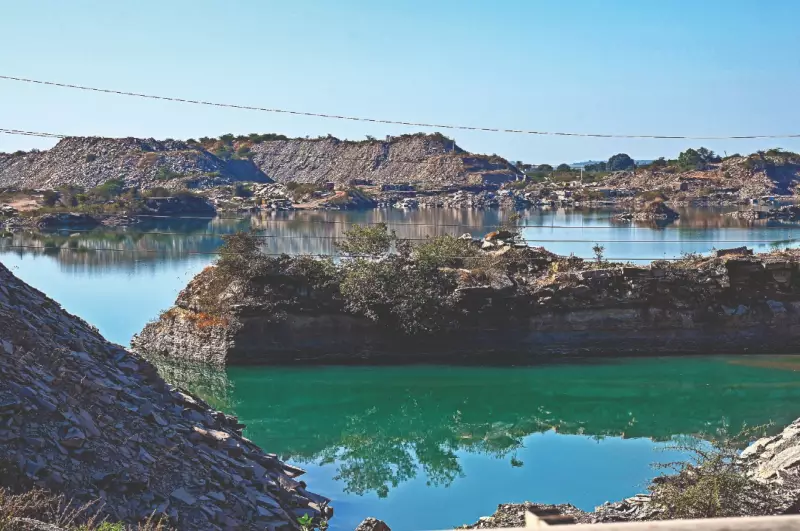
When we think of environmental destruction, images of clear-cut forests and polluted rivers come to mind. However, in India, some of the most devastating ecological losses are happening not with a roar, but with a whisper, through administrative orders and legal classifications that strip landscapes of their protected status.
The Aravali Precedent: When a Hill Stops Being a Hill
The Supreme Court of India recently provided a stark example of this phenomenon. In a move aimed at administrative clarity for mining regulation, the court accepted a height-based definition for what constitutes the Aravali hills. By setting a minimum 'local relief' threshold, the court effectively created a scenario where land continues to exist physically but ceases to exist legally for protection. Hills that fall short of the prescribed measurement are not considered harmed; they are simply excluded from safeguards.
Following significant public outcry, the Supreme Court has agreed to reconsider this order. The Aravali range is one of the planet's oldest geological formations. Its critical ecological functions—groundwater recharge, climate moderation, and maintaining ecological corridors—do not neatly correlate with its height. A metric-based definition risks leaving integral parts of this ancient system vulnerable.
The Tamil Nadu Model: Erasure by Nomenclature
A similar, yet more entrenched, pattern of ecological redefinition is evident in Tamil Nadu. The state does not use a formal height threshold. Instead, it relies on administrative and revenue classifications that achieve the same result: the removal of legal protection.
Across various districts, rocky elevations that are part of the Eastern Ghats are routinely labelled as 'minor hillocks' or 'patta lands with stone'. Once branded with this nomenclature, they vanish from the legal imagination of hill protection. This occurs even when these formations are part of continuous hill systems, act as crucial water catchments, or lie next to forest land. The physical feature and its ecological role remain, but legal concern for it disappears.
The consequences are severe. Unlike the Western Ghats, the Eastern Ghats lack a unified statutory identity. They are fragmented into survey numbers, villages, and project files. Individual permissions for quarries or land conversions seem insignificant alone, but cumulatively, they erode the entire ecological continuum. This is attrition by fragmentation.
A Systemic Preference for Labels Over Life
This pattern extends to water bodies in Tamil Nadu. Lakes and tanks are often protected only if they are officially notified or correctly classified in revenue records. Non-notified water bodies, regardless of their vital hydrological function, are treated as available land. The Madras High Court has repeatedly intervened, asserting that the ecological character of a resource cannot be defeated by a mere change in name. Yet, the constant need for such litigation reveals a deep-seated systemic preference for classification over ecological function.
This trend marks a subtle but critical shift in environmental jurisprudence. Indian law has historically leaned on the precautionary principle, where uncertainty should favour protection, as seen in landmark cases like Vellore Citizens' Welfare Forum and Godavarman. The increasing reliance on rigid administrative thresholds risks undermining this principle.
Article 21 of the Constitution, guaranteeing the right to life, has been consistently interpreted to include a healthy environment and the principle of intergenerational equity. When protection becomes contingent on qualifying criteria like height or a specific notification, this duty to future generations is diminished. Expert committees and thresholds are useful tools, but when courts adopt them without rigorous scrutiny of ecological impacts, judicial deference can turn into constitutional abdication.
The most unsettling part of this process is its quietness. The land appears intact. Only the law has turned away. There is a profound irony in the fact that the Madurai bench of the Madras High Court, which has staunchly defended water bodies from losing protection due to name changes, itself stands on land once recorded as a lake. It enforces the public trust doctrine from terrain where that trust was earlier administratively reclassified.
This irony is instructive. Nature is seldom defeated by outright denial but is frequently erased by description. A lake becomes 'poramboke land', a hill becomes a 'minor hillock', a mountain range becomes a collection of survey numbers. Nothing is 'destroyed'. Everything is merely renamed. When courts accept such classificatory logic, they risk becoming participants in the quiet erasure they are meant to prevent.