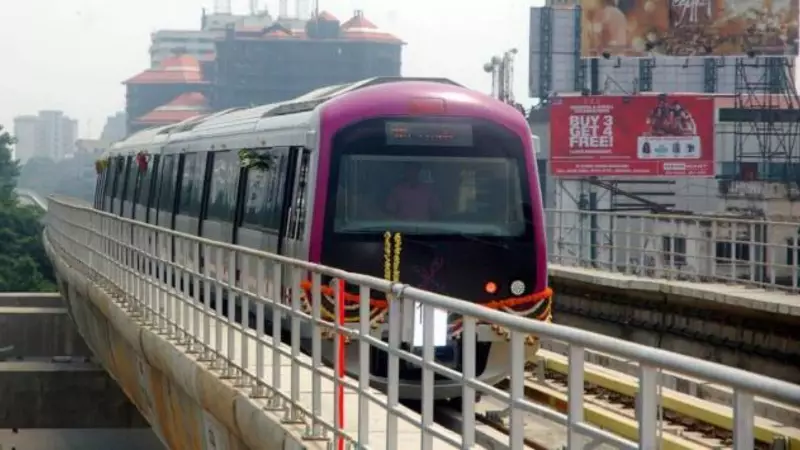
Bangalore Metro Declared Central Government Entity in Landmark Ruling
In a significant legal development, the Karnataka High Court has determined that the Bangalore Metro Rail Corporation Limited (BMRCL) falls under the authority of the Central Government for matters related to the Industrial Disputes Act. The ruling, delivered on November 3, 2025, has substantial implications for labor relations and administrative control over Bengaluru's metro rail system.
The court's decision came as it addressed multiple petitions challenging the Karnataka Government's notifications that had classified BMRCL as a public utility service under the Industrial Disputes Act and as an 'Essential Service' under the Karnataka Essential Services Maintenance Act.
Court Rejects State Government's Arguments
Justice Ananth Ramanath Hegde, presiding over the single-judge bench, delivered a comprehensive order that emphasized the Central Government's "pervasive control" over BMRCL operations. The court explicitly stated that the state government's control over the metro corporation was secondary to the Centre's overarching authority.

The state government had argued that the Centre could not be considered the appropriate authority under the Industrial Disputes Act since it doesn't hold 51 percent ownership in BMRCL. However, the court rejected this contention, establishing that shareholding percentage alone doesn't determine administrative control.
"The final say in key administrative actions is that of the Central Government and the State Government has to take approvals or concurrence from the Central Government in certain crucial administrative decisions," the bench observed in its ruling.
Legal Basis for the Decision
The court's reasoning drew from BMRCL's foundational documents and historical context. The bench noted that BMRCL, established in 2005 through registration under the Companies Act of 1956, specifically referenced the definition of a 'railway company' as defined in the Railway Act of 1890.
Although the 1890 Act had been repealed by the 1989 Railway Act when the company registered in 2005, the Memorandum of Association maintained the reference to the older legislation's definition. This legal technicality played a crucial role in the court's determination that BMRCL qualifies as a railway company rather than a public utility service under state jurisdiction.
The court elaborated that while both governments hold equal 50 percent shareholding in BMRCL, the Central Government exercises dominant control in practice. The state government "played second fiddle" in several aspects of controlling the metro corporation, requiring central approvals for crucial administrative decisions.
Implications and Outcome
As a direct consequence of this ruling, the challenged notifications issued by the Karnataka Government were struck down by the high court. This decision redefines the legal framework governing labor disputes and essential service declarations affecting thousands of BMRCL employees.
The judgment establishes that for all matters pertaining to the Industrial Disputes Act, BMRCL employees will now fall under central government jurisdiction rather than state government authority. This could potentially alter how labor disputes are handled and what regulations apply to metro rail operations in Bengaluru.
The case involved petitions from both the BMRCL Employees Union and the Central Government, highlighting the complex interplay between state and central authorities in managing critical urban infrastructure projects. The ruling sets an important precedent for similar metro rail corporations across India that operate under joint central-state ownership structures.
This decision comes at a time when Bengaluru's metro system is undergoing significant expansion, making the clarification of administrative control particularly relevant for future labor relations and operational management.