Protests against the Iranian regime reached the heart of London over the weekend, with demonstrators targeting the country's embassy in a dramatic act of defiance. The incident occurred as global demonstrations continue in solidarity with ongoing unrest within Iran, driven by economic hardship and political dissent.
London Embassy Incident and Arrests
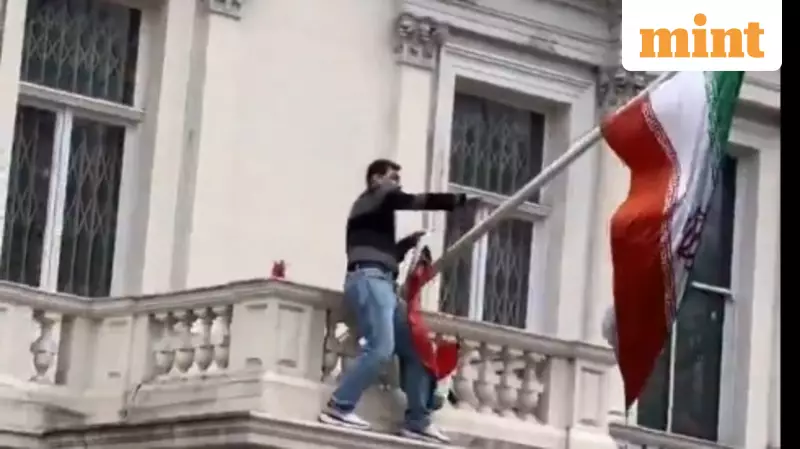
On Saturday, a significant demonstration took place outside the Iranian embassy in Kensington, Central London. The Metropolitan Police estimated that between 500 to 1,000 people participated at the peak of the protest. The event took a dramatic turn when a protestor, in an act captured on social media, scaled the embassy's balcony.
This individual removed the current national flag of the Islamic Republic and replaced it with the pre-1979 'lion and sun' emblem, a symbol widely adopted by opposition groups. Following the incident, police made two arrests. One person was detained for aggravated trespass and assault on an emergency worker, while another was arrested solely for aggravated trespass. Authorities are also searching for a third individual connected to the trespass.

The police stated they saw no serious disorder and confirmed officers would remain in the area to ensure embassy security. The Iranian embassy later responded by sharing a photo on its X (formerly Twitter) account showing the national flag restored, with the caption "Iran’s flag is flying high".
Global Demonstrations and Political Reactions
The London protest was part of a coordinated international response. In Berlin, Germany, hundreds of protesters marched through the capital, waving the former imperial flag and holding pictures of exiled crown prince Reza Pahlavi. The son of Iran's last Shah, who is based in the United States, had urged people to take to the streets on Saturday and Sunday to "seize city centres."
Pahlavi, 65, specifically called for the raising of the pre-1979 flag and declared the goal was to bring the Islamic Republic "to its knees." The UK government expressed serious concern over the reported violence against peaceful protesters in Iran. Newly elected Prime Minister Keir Starmer condemned the killings of protesters and called on Tehran to show restraint.
Roots of the Unrest in Iran
The current wave of protests inside Iran began on December 28 and has since spread nationwide. Initial grievances focused on soaring food prices and the country's crippling annual inflation, but demonstrations have increasingly featured anti-government slogans. The economic crisis, marked by a collapsing currency, has fueled public anger.
As internet services remain disrupted and phone lines cut, a human rights group reported on Sunday that the death toll has risen sharply. At least 192 people have died over two weeks of protests, a significant increase from the previously reported figure of 51. The situation continues to be monitored closely by international observers amid fears of further escalation.