Indore's Rural Black Spots: A Deadly Legacy of 112 Lives Lost
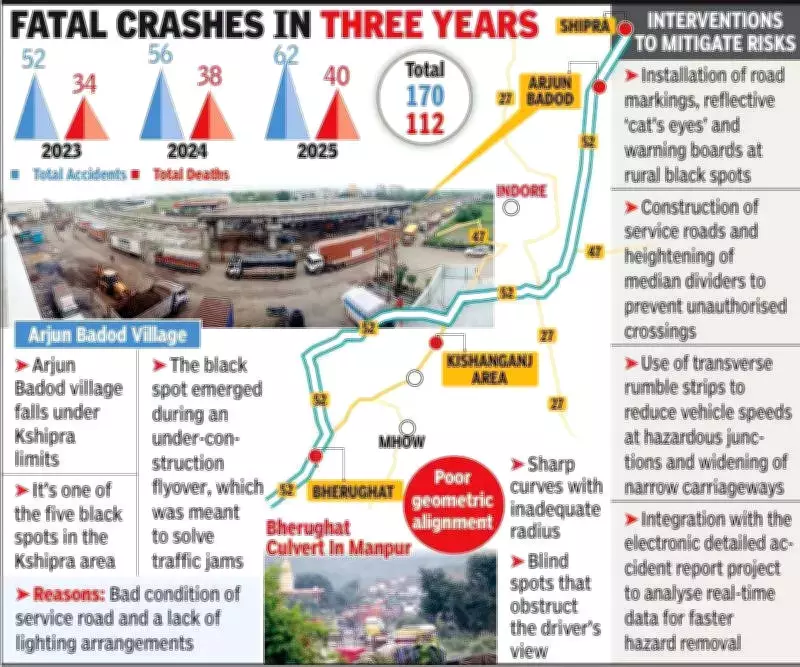
A grim tally has emerged from rural Indore, where 15 identified black spots have become sites of tragedy, claiming 112 lives over the last three calendar years. These hazardous locations have been linked to 170 reported road accidents, exposing critical failures in traffic infrastructure and management.
Concentration on AB Road and Kshipra
Most of these dangerous zones are concentrated on AB Road, specifically at the Bherughat culvert in Manpur and multiple points along Kshipra. The Kshipra area alone harbors a maximum of five black spots, making it a particularly perilous corridor for motorists.
One notably ironic black spot has emerged in Arjun Badod village, where an under-construction flyover—intended to alleviate traffic congestion—has instead become a hazard. The poor condition of the service road and a complete lack of lighting arrangements have led to multiple accidents, including fatal ones, at this very site meant to improve safety.
Root Causes: Poor Design and Neglect
Local insights reveal deep-seated issues. Farmer leader Bablu Jadav highlighted to TOI that most black spots on AB Road, including those in Kshipra, suffer from poor geometric alignment, sharp curves with inadequate radius, and 'blind spots' that dangerously obstruct drivers' views. Compounding these design flaws are a lack of proper street lighting and overgrown vegetation on road shoulders, which hide oncoming traffic at intersections.
Resident Ajay Patidar from Kishanganj area pointed to additional factors: rampant speeding on highways and a widespread lack of protective gear among two-wheeler riders. He emphasized, "Besides, the absence of forgiving road features such as crash barriers, rumble strips, and proper signage also results in accidents." Kishanganj itself hosts three black spots, including areas near Tihi culvert, Pigdambar square, and Maa Vaishnodevi dhaba.
Traffic Management Disparity Between City and Rural Areas
A stark contrast in resources exacerbates the problem. While Indore city's traffic wing operates with two police stations, a staff of around 1,000 personnel, and full equipment and vehicles, the rural wing is severely understaffed. It has only one DSP to coordinate with neighboring districts and handle clerical work.
DSP Umakant Choudhary confirmed to TOI that requests have been made to headquarters for essential resources: a traffic police station, adequate staff, equipment, and vehicles. However, these needs remain unmet, leaving rural areas vulnerable.
Official Response and Ongoing Efforts
IG (rural) Anurag stated that traffic management in these areas is the responsibility of the respective local police stations. He noted that efforts are ongoing to meet the requirements of the rural traffic wing. "Staff at the police stations in rural areas managed traffic-related arrangements," he said, adding that the road safety committee regularly reviews traffic issues, including steps to remove black spots. According to him, decisions from this committee prompt coordinated action by concerned agencies and the respective rural police stations.
Despite these assurances, the persistent death toll at these black spots underscores an urgent need for comprehensive infrastructure upgrades, better lighting, vegetation control, and enhanced traffic policing in rural Indore to prevent further loss of life on its dangerous roads.