Telangana High Court Raises Alarm Over Severe Pollution in Hyderabad's Vital Reservoirs
The Telangana High Court on Monday voiced profound concern regarding the dangerously high pollution levels detected in Hyderabad's twin reservoirs, Himayatsagar and Osmansagar. The contamination, stemming from industrial effluents, agricultural run-off, and untreated sewage, has rendered the water sources unfit for human consumption, posing a critical public health threat.
Court Directs Swift Action and Warns of Penalties
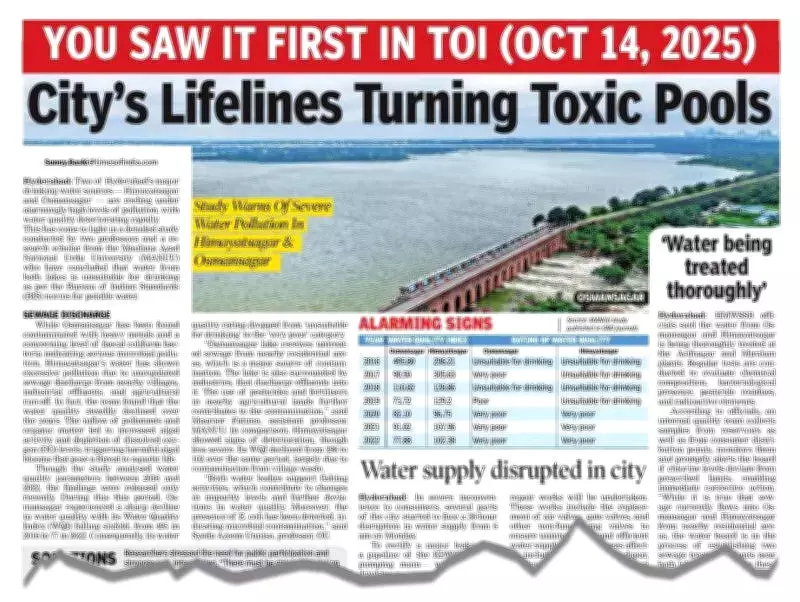
A division bench, led by Chief Justice Aparesh Kumar Singh and Justice G M Mohiuddin, was hearing a public interest litigation (PIL) initiated based on a letter referencing a Times of India report from October 2025 titled 'City's lifelines turning toxic pools'. The bench rigorously questioned authorities on their failure to prevent waste discharge into the reservoirs and ensure proper water treatment before supply to Hyderabad and Secunderabad.
The court issued a directive to the state government and relevant departments, including the irrigation and command area development department, HMWS&SB, and the Pollution Control Board, to file detailed responses within four weeks. It explicitly warned of imposing fines if compliance is not met by the next hearing date, scheduled for March 23.
Research Reveals Alarming Contamination Levels
The TOI report highlighted a study conducted by Maulana Azad National Urdu University (MANUU), which exposed that Osmansagar and Himayatsagar have transformed into "toxic pools" due to severe degradation from pollutants. The research identified contamination from untreated sewage, industrial waste, and agricultural run-off as primary culprits, with several city lakes also contaminated by heavy metals and high concentrations of faecal bacteria, making the water non-potable and hazardous.
Excessive pollution is largely attributed to unregulated sewage discharge from surrounding villages, along with industrial effluents and agricultural run-off, exacerbating the crisis.
Judicial Emphasis on Accountability and Public Health
During the proceedings, the bench challenged counsels representing various government departments, questioning how authorities could evade their responsibility in maintaining these crucial water sources. "Ultimately, all of us have to understand that we are the ones who are going to consume that water," the bench remarked, underscoring the collective impact of negligence.
In addition to the initial directives, the court ordered the Greater Hyderabad Municipal Corporation and the Municipal Administration and Urban Development department to submit affidavits outlining measures taken to prevent polluted sewage inflow from neighbouring habitations, colonies, villages, and industrial units into the reservoirs.
This case highlights escalating environmental and health concerns in Hyderabad, with judicial intervention pushing for urgent remedial actions to safeguard water quality and public welfare.