Gujarat's Coastal Frontline in India's War on Narcotics
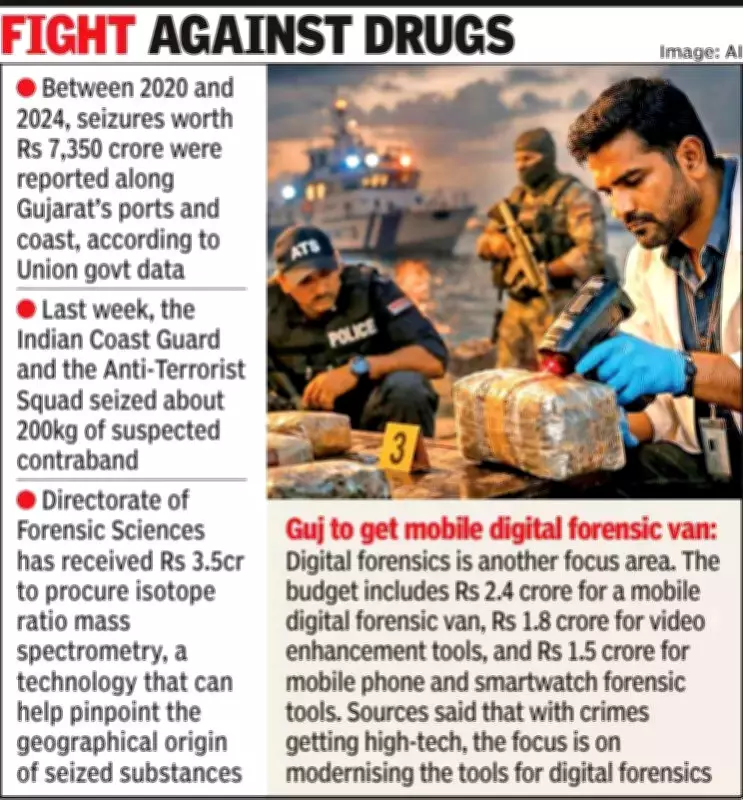
Ahmedabad: Gujarat's extensive coastline, stretching over 1,600 kilometers, has emerged as a critical battleground in India's ongoing fight against narcotics trafficking. According to data released by the Union government, authorities have intercepted drugs worth a staggering Rs 7,350 crore along Gujarat's ports and coastal areas between 2020 and 2024.
The magnitude of this challenge became particularly evident in 2023 alone, when narcotics valued at approximately Rs 1,800 crore were seized. Just earlier this week, a joint operation by the Indian Coast Guard and the Anti-Terrorist Squad resulted in the confiscation of about 200 kilograms of suspected contraband, underscoring that the illicit flow remains persistent.
Forensic Technology: The New Weapon in Gujarat's Arsenal
In response to this escalating threat, Gujarat's enforcement agencies are pivoting toward sophisticated forensic technologies. The objective extends beyond mere detection to tracing narcotics back to their geographical origins, thereby dismantling trafficking networks at their source.
This strategic shift has received substantial financial backing in the state's latest budget, with crores allocated to upgrade the capabilities of the Directorate of Forensic Sciences (DFS). A significant portion of this investment is directed toward narcotics analysis, DNA profiling, and digital forensics.
Isotope Ratio Mass Spectrometry: Tracing Narcotics to Their Roots
The DFS has been granted Rs 3.5 crore specifically to acquire isotope ratio mass spectrometry (IRMS) technology. This advanced equipment measures natural stable isotope variations present in materials and compares them against updated isotope libraries linked to specific regions.
"Even if two substances appear identical, their isotope signatures can differ based on where they were produced or processed," explained DFS sources. "The IRMS distinguishes between identical-looking substances and can be used for natural, synthetic, and semi-synthetic contraband. It will help link a haul to a specific region and trace the route taken by peddlers."
Investigators believe this capability will significantly strengthen legal cases by connecting consignments directly to production zones and mapping trafficking corridors, rather than treating each seizure as an isolated incident.
Raman Spectroscopy for Rapid Field Detection
To complement laboratory analysis with swift field-level operations, the DFS has also received Rs 2 crore for a Raman spectroscopy handheld narcotic analyzer. This device enables non-destructive identification of drugs through molecular fingerprints detected by laser, allowing for quicker screening without compromising evidence integrity.
Beyond Narcotics: DNA and Digital Forensics Upgrades
The technological push extends well beyond narcotics. The DNA division at DFS Gandhinagar is set to receive a mixture and probabilistic genotyping forensic tool costing Rs 7.44 crore, marking one of the first such systems in Indian forensic science laboratories.
"The tool is designed for complex cases where there is more than one sample of human fluids or DNA at a crime scene, or where the sample is relatively older," said sources. "In several instances, the DNA extracted is insufficient for analysis. This tool will help fill these gaps, improving both the speed and quality of forensic examination."
This technology is expected to prove particularly valuable in sexual offence cases involving multiple perpetrators.
Learning from Tragedy: High-Throughput DNA Processing
Drawing lessons from last year's AI 171 airplane crash, which necessitated rapid victim identification, the DFS has secured allocations for high-throughput DNA extraction and automated processes for DNA quantification and amplification with validation technology. The goal is to enable faster processing of large volumes of samples during mass-casualty situations.
Mobile Digital Forensic Van and Enhanced Tools
Digital forensics represents another critical focus area. The budget includes Rs 2.39 crore for a mobile digital forensic van, Rs 1.85 crore for video enhancement tools, and Rs 1.5 crore for mobile phone and smartwatch forensic tools.
"With crimes becoming increasingly high-tech, modernizing digital forensic tools is essential," emphasized sources. "For example, the van will facilitate on-field analysis in critical cases, including data extraction from suspected devices. The focus is squarely on reducing investigation time and improving accuracy."
This comprehensive technological overhaul positions Gujarat at the forefront of forensic innovation in India, aiming not only to intercept narcotics but to systematically dismantle the networks that fuel their trade along one of the nation's most vulnerable coastlines.