Ghaziabad's roads have turned perilous, with official data painting a grim picture of traffic safety. Between January 1 and November 30 this year, the city witnessed a staggering average of three accidents every single day. This relentless toll resulted in more than one death and two injuries daily, highlighting a severe public safety crisis.
A Disturbing Three-Year Trend
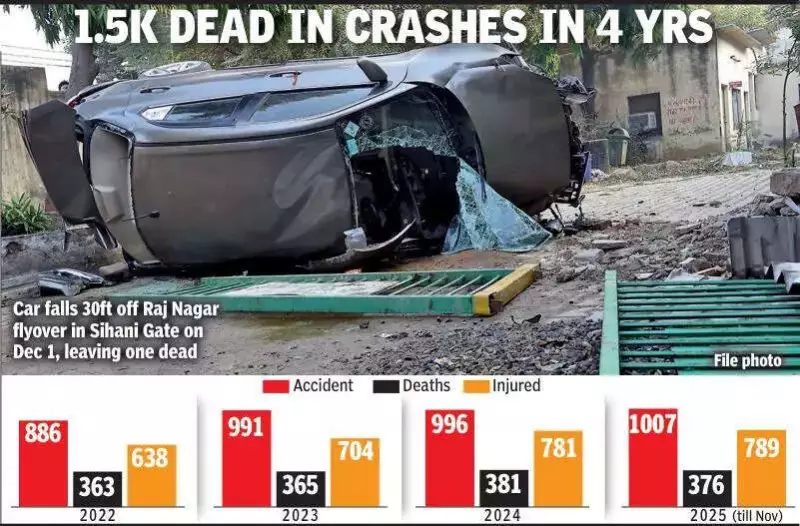
The statistics released by the traffic department are alarming. In the first eleven months of the year, a total of 1,007 accidents occurred, claiming 376 lives and leaving 770 people injured. This data indicates a worrying increase compared to the previous years. For the full calendar year 2024, the city recorded 996 accidents with 381 fatalities and 789 injuries. The numbers for 2023 were similarly high, with 991 accidents causing 365 deaths and injuring 704 people.
Police Response: Identifying Black Spots and Deploying Special Teams
Confronted by these persistent numbers, senior police officials have outlined a multi-pronged strategy. Additional Commissioner of Police (Law and Order and Traffic) Alok Priyadarshi stated that concerted efforts are underway to reduce accidents and fatalities. The traffic police have pinpointed 14 key locations with abnormally high accident rates.

To address these danger zones, a Critical Corridor Team (CCT) has been formed for each spot. Each team comprises one sub-inspector and four constables. One of the most critical stretches identified is the Delhi-Meerut Expressway (DME) under Modinagar police jurisdiction. This corridor was flagged based on accident data from October 2022 to October 2025, which recorded 46 accidents and 48 deaths. Consequently, the Modinagar police station has been designated a Critical Police Station.
Special Equipment and Training for Enforcement
The police are equipping these special teams with modern technology for effective enforcement. "For effective enforcement and accident control on the said critical corridor, a special team has been nominated at the police station level comprising 1 sub-inspector and 4 head constables, who have been provided with speed laser guns, breath analysers, decibel meters, and body-worn cameras," explained Additional CP Priyadarshi.
Beyond enforcement, the CCTs will also receive first-aid training from government hospital doctors. These teams have a proactive mandate to investigate the root causes of accidents. "This team also investigates the cause of the accident. If there is any engineering fault or any other issue, it will be solved by the concerned authorities," the officer added.
Boosting Manpower and Challan Drive
To bolster these efforts, the district has significantly increased its traffic police strength. The number of personnel has been raised from 666 to 883. "Now, there are three traffic ACPs working; earlier, there was only one. There are now 12 traffic inspectors, 135 traffic sub-inspectors, 312 head constables, and 421 constables. The duty points have also increased from 176 to 237," detailed the officer.
Enforcement has been rigorous. As of November 30, nearly 13 lakh (1.3 million) challans were issued for various traffic offences this year. This follows 13 lakh challans in 2024 (Jan-Dec) and over 16 lakh in 2023. With the winter fog season reducing visibility, traffic cops are actively removing vehicles parked on NH-9 and DME to prevent collisions.
Recent Tragedies Underscore the Urgency
The urgency of these measures is underscored by recent fatal incidents. On December 1, a 50-year-old man died and his 25-year-old son was critically injured when their car plunged 30 feet from the Raj Nagar flyover. Earlier, on November 24, a 25-year-old private college teacher was killed and her father injured when a bus hit their two-wheeler near the Guldhar Rapid Metro station.
After focusing on the Modinagar stretch, police will shift resources to the DME stretch from UP Gate to Dasna. With enhanced teams, better equipment, and targeted strategies, Ghaziabad police aim to curb the relentless wave of road accidents that has plagued the city for years.