Former Chief Justice NV Ramana Criticizes Government's Approach to Gender Parity in Judiciary
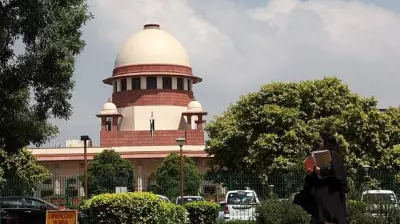
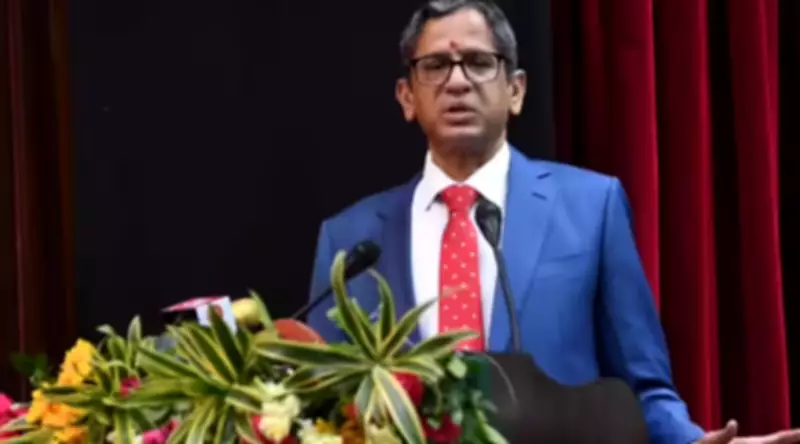
In a significant and thought-provoking address delivered on International Women's Day, former Chief Justice of India NV Ramana made a startling disclosure regarding the government's approach to achieving gender parity within the constitutional courts of India. Speaking candidly at the first national conference of 'Indian Women in Law' held at the Supreme Court, Justice Ramana asserted that the government either lacks the necessary intent or the determination to ensure balanced representation of women in the higher judiciary.
Disparity Between Trial Courts and Higher Judiciary
Justice Ramana highlighted a critical contradiction in the judicial system. While there is a commendable and healthy representation of approximately 40% women among trial court judges across the nation, this proportion drastically diminishes in the constitutional courts. The former CJI, who served from April 2021 to August 2022 and faced numerous pressures during his tenure, pointedly remarked, "The government always showed a casual attitude in appointments of women as judges of the Supreme Court and high courts."
He elaborated on the government's approach, noting that although successive law ministers have routinely requested high court chief justices to recommend names of women advocates and judicial officers for appointment as high court judges, the government has never strongly insisted on effective representation of women in each and every recommendation. This lack of insistence, according to Justice Ramana, signifies a deeper issue of intent.

Historical Appointments and Current Statistics
During Justice Ramana's tenure as the head of the collegium, a historic moment occurred on August 31, 2021, when three women judges—Justices Hima Kohli, Bela M. Trivedi, and B.V. Nagarathna—took their oaths simultaneously. This event marked a significant step forward. However, no additional woman judge has been appointed to the Supreme Court since that date, despite the leadership passing through five subsequent Chief Justices: U.U. Lalit, D.Y. Chandrachud, Sanjiv Khanna, B.R. Gavai, and the current CJI, Surya Kant.
The current statistics reveal a stark imbalance:
- Out of a sanctioned strength of 1,122 high court judges, only 116 are women.
- The Supreme Court, with a sanctioned strength of 34 judges, currently has only one woman judge.
Justice Ramana emphasized that it would be unfair to place the entire blame for this skewed representation solely on the government. He stated, "The judiciary must respond with sincerity towards inclusivity as there is no dearth of talented women lawyers who can be high court judges."
Future Prospects and Calls for Action
Speaking in the presence of Justice B.V. Nagarathna, who is set to become the first woman Chief Justice of India on September 24, 2025, Justice Ramana noted that there are two future CJIs in the gathering, referring to Justice Nagarathna and her successor, Justice P.S. Narasimha. He expressed hope that during their tenures, at least seven to eight women judges will be appointed to the Supreme Court, thereby addressing the current disparity.
Justice Nagarathna, who will retire on October 29, 2027, responded by assuring Justice Ramana that she would endeavor to the best of her ability to facilitate the appointment of more women judges to the apex court.
Addressing the Talent Pool and Systemic Issues
Justice Ramana further elaborated on the availability of qualified women in the legal profession. He observed that, with the exception of a few high courts, most major metropolitan centers boast a large pool of highly competent women lawyers. "It is very worrisome as to why these numbers are not reflected in the judicial appointments," he remarked, underscoring a systemic failure to tap into this reservoir of talent.

The former Chief Justice's remarks serve as a powerful critique and a call to action for both the government and the judiciary. They highlight the urgent need for a more determined and intentional approach to ensure that gender parity is not just an ideal discussed on International Women's Day but a reality achieved within the halls of India's highest courts. The dialogue initiated at the conference underscores the collective responsibility to foster inclusivity and leverage the full spectrum of legal expertise available in the country.