

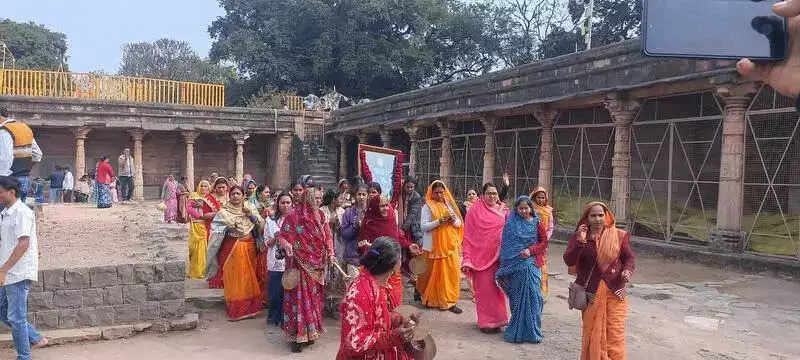
The Maulana Kamaluddin Welfare Society, based in Madhya Pradesh's Dhar district, has strongly condemned the namaaz arrangements made at the contentious Vahgvedi Temple-Kamal Maula Bhojshala site during Basant Panchami celebrations on Friday. The society labeled the administration's actions as condemnable and accused them of attempting to defraud the Muslim community, while also constituting a contempt of the Supreme Court. The group has issued a stern warning, threatening to pursue legal action against the Dhar district administration for what it perceives as a blatant disregard of judicial directives.
Allegations of Administrative Failure
Abdul Samad, a functionary of the society, addressed the media, highlighting the administration's alleged failure to implement a Supreme Court order. This order specifically mandated that namaaz be offered by the Muslim party between 1 pm and 3 pm, with provisions for separate entry and exit points within the premises. Samad emphasized that the court's directive was clear and unambiguous, yet the administration did not provide the designated opportunity as required.
Unaddressed Concerns and Legal Threats
Samad further revealed that the community had raised objections with the district collector, but their concerns were reportedly ignored. We wrote to the collector, but they did not pay attention to us, he stated, adding that the society plans to move court to plead for contempt of the court. This move underscores the escalating tensions and the community's determination to seek judicial recourse.

Dispute Over Namaaz Location
The core of the society's objection revolves around the location designated for namaaz. Samad claimed that the Archaeological Survey of India (ASI) map is incorrect, and the community presented evidence to the collector indicating that survey numbers 317, 316, 312, 912, and 918 are listed as Waqf cemetery land. We will not offer namaaz in the cemetery, Samad asserted, stressing that the community insists on offering salat inside the premises as per their interpretation of the court order.
Administration's Response
In contrast, Dhar district collector Priyank Mishra defended the arrangements after the Basant Panchami event. He stated that both Hindus and Muslims were allowed to offer prayers and namaaz uninterrupted. Mishra clarified that a designated place for Muslims to offer namaaz inside the complex was communicated to them in writing, and approximately 15-17 community members performed namaaz without disruption between 1 pm and 3 pm.
Historical Context of the Bhojshala Dispute
The Bhojshala-Kamal Maula mosque has long been a flashpoint for communal tensions in Dhar town. Hindus claim the site as the Vaghdevi (Goddess Saraswati) temple, predating the construction of a mosque, while Muslims dispute this, citing a 1902-03 ASI survey that found no evidence of a temple. The dispute intensified with a 2003 ASI order, which allowed Hindus to worship at Bhojshala every Tuesday and Muslims to offer namaz every Friday afternoon, typically from 1 pm to 3 pm. On Basant Panchami, Hindus were granted access for the entire day for puja, provided it did not clash with a Friday.
Supreme Court's Recent Clarification
Adding to the complexity, the Supreme Court provided clarity on Thursday regarding religious activities at the contested site on Friday. The court granted Hindus access from dawn to dusk and allocated a two-hour window between 1 pm and 3 pm for Muslims to offer namaaz. This ruling aimed to balance religious practices but has now sparked fresh controversy over its implementation, as evidenced by the Maulana Kamaluddin Welfare Society's grievances and threats of legal action.






