Chief Justice of India (CJI) Justice Surya Kant on Friday unveiled a transformative vision for India's judicial system, advocating for a shift from traditional litigation-centric courts to comprehensive "multi-door courthouses". He made these remarks during the inaugural session of the Bar Council of India's national conference and symposium on mediation, held in Sancoale, Goa.
From Adversarial Trials to Multiple Pathways
Justice Kant articulated that the future of Indian courts lies in becoming hubs that offer litigants various avenues for resolving their disputes. "As we look towards the horizon, I envision a transition towards the multi-door courthouse," he stated. The concept proposes that when individuals approach the court, they should be presented with multiple options tailored to their specific case, including mediation, arbitration, and litigation as a last resort.
He emphasised that this model represents the "ultimate empowerment of litigants," fostering participation and harmony rather than relying solely on adversarial court battles. "The court should not remain a singular venue for trials, but become a comprehensive centre for dispute resolution," the CJI added.

Mediation: The Highest Evolution of Law
Justice Kant placed significant emphasis on the role of Alternative Dispute Resolution (ADR), particularly mediation. He described it as a sign of the law's strength, not weakness. "Mediation is not a sign of the law's weakness, but its highest evolution. It's a true transition from a culture of adjudication to a culture of participation where we cultivate harmony," he remarked.
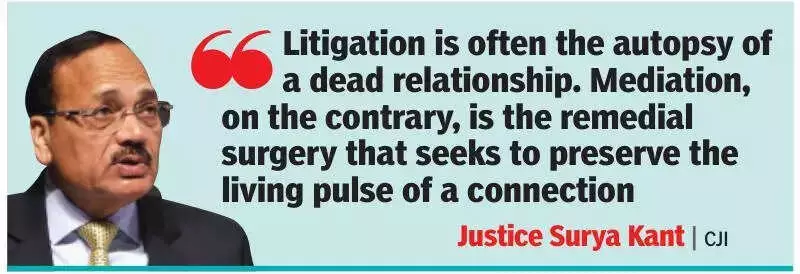
Drawing a powerful analogy, the CJI said, "Litigation is often the autopsy of a dead relationship. Mediation, on the contrary, is the remedial surgery that seeks to preserve the living pulse of a connection." He administered an 'Oath of Mediation' to the participants, calling mediation a cause close to his heart.
The Challenge of Scaling Up Mediation
The CJI highlighted a critical gap in the current system. While India has approximately 39,000 trained mediators, he stressed that effective nationwide implementation requires a force of over 2.5 lakh trained professionals. He pointed out that a mediator's success depends on understanding local dialects, expressions, and cultural contexts, not just language.
"The temperament, behaviour, compassion, passion, commitment and devotion of a mediator make a crucial difference," Justice Kant noted, underscoring the need for careful and high-quality training programs.
Ongoing National Efforts and Success Rates
Earlier in the day at a walkathon in Panaji, the CJI revealed that the Supreme Court has been actively persuading high courts and district courts across India to identify cases suitable for mediation. "We have been able to persuade our high courts, our district courts to identify certain matters which could be sent for mediation and this is an ongoing process," he said.
He confirmed that this process would continue for both backlogged and fresh cases. Encouragingly, Justice Kant shared that the success rate for mediation has increased by more than 30% in the last few years, indicating growing acceptance and effectiveness.
The conference at the India International University of Legal Education and Research was attended by Goa Chief Minister Pramod Sawant, several Supreme Court judges, Bombay High Court Chief Justice S Chandrasekhar, and Bar Council of India chairman Manan Kumar Mishra.