Calcutta High Court Overturns 36-Year-Old Dowry Death Conviction
In a landmark ruling, the Calcutta High Court on Thursday quashed a 36-year-old conviction against a man from Midnapore, who had been found guilty of abetting the suicide of his pregnant wife through persistent dowry demands and physical harassment. The court stated that the prosecution failed to produce sufficient evidence demonstrating that the husband or his mother had "instigated, conspired, or intentionally aided" in the suicide.
Legal Reasoning Behind the Quashing
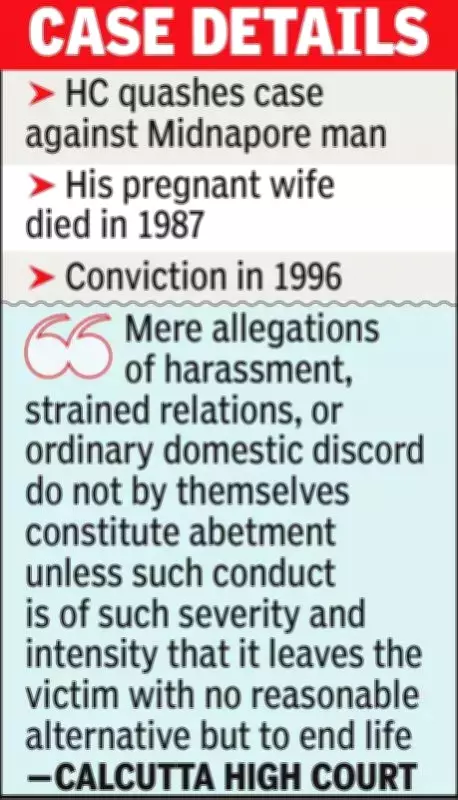
Justice Prasenjit Biswas, presiding over a single-judge bench, emphasized that abetment of suicide requires a direct and proximate causal link between the accused's actions and the victim's decision to end their life. In his judgment, he noted, "Abetment of suicide is intrinsically linked to the mental process of instigating, encouraging, or intentionally aiding a person to commit self-destruction. Mere allegations of harassment, strained relations, or ordinary domestic discord do not by themselves constitute abetment unless such conduct is of such severity and intensity that it leaves the victim with no reasonable alternative but to end life."
The court highlighted that remote or indirect conduct, without a clear causal connection, does not meet the statutory threshold for conviction under abetment laws. This ruling underscores the necessity for concrete evidence in such sensitive cases.
Background of the Case
The case dates back to 1987, when the pregnant wife died by suicide. In 1990, the husband and his mother were convicted based on a complaint filed by the victim's brother, who alleged that repeated dowry demands, physical harassment, and mental cruelty drove his sister to take her own life. Testimonies from the victim's father, mother, and sister-in-law supported this claim.
However, during the appeal process, the husband was on bail, and his mother passed away. Justice Biswas directed the quashing of the conviction, citing several procedural and evidentiary lapses.
Evidentiary Shortcomings Noted by the Court
The court pointed out critical gaps in the prosecution's case. Firstly, it observed that none of the four family members who testified took any action to intervene or report the harassment to authorities while the victim was alive. "An allegation that a married woman conveyed her intention to end life due to dowry-related harassment is an extremely serious matter. The natural and expected conduct of a responsible family member was to immediately approach the authorities or at least attempt some form of intervention," Justice Biswas remarked.
Additionally, the court noted that key elements of the allegations, such as demands for additional dowry or physical harassment, were communicated to a magistrate but not to the investigating police officers. This discrepancy raised questions about the consistency and reliability of the evidence.
Medical Evidence and Forensic Oversights
Another significant issue highlighted was the lack of proper medical documentation. The autopsy report and medical records were not formally exhibited in court. Instead, reliance was placed solely on the oral statement of a doctor, who described the death as unnatural due to "ante-mortem hanging, which was likely suicidal."
Justice Biswas criticized this omission, stating, "Such omission cannot be treated as a mere technical defect; rather, it goes to the root of the matter… In forensic and medico-legal practice, an opinion regarding the unnatural nature of death must ordinarily be supported by visible injuries, external signs, or circumstances observed upon examination..." This underscored the importance of robust forensic evidence in establishing the cause and circumstances of death.
Implications of the Ruling
This decision by the Calcutta High Court sets a precedent for how dowry death and suicide abetment cases are adjudicated, emphasizing the need for clear, direct evidence linking the accused's actions to the suicide. It also highlights the critical role of timely intervention by family members and authorities in preventing such tragedies.
The ruling serves as a reminder of the legal complexities involved in cases of domestic violence and dowry harassment, where emotional allegations must be substantiated with concrete proof to secure a conviction.